4 Days in Asturias: Bear Watching Trip in Spain with Hearty Stews & Alpine Hikes
LAST UPDATED: 28th August 2026 | ORIGINAL: 22nd July 2026
Planning a bear-watching trip in Asturias usually starts with one simple search: when can I actually see a wild brown bear? What you quickly realise is that it is not just about timing but about how you use the rest of your day.
The tricky part is making it all fit together. Bear activity peaks at dawn and dusk, so your itinerary needs to work around those windows. That means choosing the right base, finding hikes that are worth your time, and adding in flexible experiences that complement the slower pace of wildlife watching.
This four-day Asturias itinerary is built with that in mind. It is for travellers who want the thrill of spotting a Cantabrian brown bear but also want to experience the landscapes, food, and culture along the way. There will be no shortage of breathtaking hikes in Green Spain, tranquil villages, spectacular coastal views, and long lunches in between.
Bear (excuse the pun) in mind that 4 days in Asturias will never feel like enough, but it gave me just enough time to properly get into it. I left already thinking about what I missed… And yes, I will absolutely be back.

Steal My 4 Days In Asturias Itinerary
Day One in Asturias
- Travel to Oviedo.
- Picturesque coastal town of San Esteban de Pravia and have lunch at Gran Hotel Brillante.
- Head to Mirador del Espíritu Santo for views over the Cantabrian Sea and the Nalón estuary.
- Check in at Hotel Casa Miño in Pola de Somiedo, in Somiedo Natural Park.
- Visit The Bear House (Casa del Oso) to learn about the Cantabrian brown bear.
- Head to a nearby viewpoint for your first chance at spotting a bear in the wild.
- Dinner at Hotel Casa Miño
Day Two in Asturias
- Up early for another chance to spot brown bears at sunrise
- Breakfast at Hotel Casa Miño
- Visit the heritage village of Perlunes
- Stop at the Ecomuseo de Somiedo in Veigas
- Back to Pola de Somiedo for lunch, wander and visit the Interpretation Centre of Somiedo Natural Park
- Walk in La Malva ancient forest
- Brown bear observation at dusk
- Dinner at Hotel Casa Miño
Day Three in Asturias
- Up early for a brown bear sighting session at dawn
- Breakfast at Hotel Casa Miño
- Hiking day to Valle de Lago (“Valley of the Lake”), one of Somiedo’s most scenic routes.
- Brown bear observation at dusk
- Dinner at Hotel Casa Miño
Day Four in Asturias
- Breakfast at Hotel Casa Miño
- Bird-watching along the Villaviciosa estuary, a haven for migratory species
- Lunch at a traditional cider bar in Oviedo with cider pouring the Asturian way
- Visit the UNESCO-listed monuments on Mount Naranco, just outside the city
- Head to Cabo Peñas lighthouse, perched on the highest cliffs in Asturias
- Depart from Oviedo

Is 4 Days in Asturias Enough?
Probably not! Four days in Asturias is just enough to fall for it but not nearly enough to feel like you’ve seen it all. This is a region where dramatic coastline, misty mountains, wildlife-rich national parks, and food worth planning a trip around all sit within a short drive of each other. You can wake up by the sea, hike through alpine valleys by midday, and be scanning hillsides for brown bears by sunset.

How To Plan a Bear-Watching Trip in Asturias
The Conservation Story of Cantabrian Brown Bears
The Cantabrian brown bear is one of Spain’s greatest conservation wins. Just a few decades ago, they were listed as ‘endangered of extinction’ with a surviving population of 70-80 bears with only a handful of breeding females. Their numbers were so low due to habitat degradation, human disturbance and illegal hunting.
Today, thanks to long-term protection efforts, stricter laws, and the work of organisations like Fundación Oso Pardo, the population has slowly recovered and is now estimated to be over 450 bears, mostly in Somiedo Natural Park.
What makes this recovery especially interesting is how closely it is tied to local communities. Conservation here is not just about protecting the bears but also about supporting rural life and creating a balance between people and wildlife. Initiatives such as eco-tourism, education, and sustainable land use have helped shift attitudes and provide new opportunities.
“The philosophy guiding FOP’s work is based on the development of management experiences which demonstrate the viability of the coexistence between human activities and a wild bear population.” Fundación Oso Pardo (FOP-Brown Bear Foundation)

Best time of year for bear watching
Timing your trip to Someido makes a huge difference for your chances of spotting a bear.
- Spring (April–June) is one of the best times to visit. Bears emerge from hibernation and are actively foraging, often visible on open hillsides. The landscape is also at its most colourful, with wildflowers and fresh greenery everywhere.
- Autumn (September–October) is another prime window. Bears are busy feeding before winter, increasing the likelihood of sightings. The changing colours of the forests add a dramatic backdrop.
- Summer (July–August) can still be good, but sightings are less predictable due to heat. Bears tend to stay higher up or move during cooler hours.
- Winter (November–March) is the least reliable, as many bears are in hibernation and access to some areas can be limited by weather.
No matter the season, the best time of day is always early morning (just after sunrise) and late evening (around dusk) when bears are most active.

Stay in Someido Natural Park
To maximise your chances of seeing a bear, it is important to stay within Somiedo Natural Park. Bear activity happens at dawn and dusk, so being close to the main observation areas allows you to take full advantage of these key times without losing precious hours to travel.
Staying in places like Pola de Somiedo also makes the experience more immersive, with mountains and wildlife all around you. Choosing small, locally run hotels or guesthouses helps support the community that plays a key role in protecting this landscape while also giving you up-to-date insights on recent bear sightings.
|| BOOK YOUR STAY IN POLA DE SOMIEDO
Go with a local guide
Going with a local guide greatly improves your chances of seeing a bear, especially if your time is limited and only have 4 days in Asturias. Guides understand the terrain, track recent bear activity, and know the best viewpoints. While it is possible to explore on your own, bear sightings are never guaranteed, and knowing where to look is half the challenge. They also provide equipment such as spotting scopes, which are essential since bears are usually seen at a distance.
Just as importantly, guided tours follow an ethical approach that prioritises the wellbeing of the animals. Observations are made from a safe distance, allowing bears to behave naturally without disturbance, while you gain a deeper understanding of their behaviour, conservation efforts, and the relationship between wildlife and local communities.
|| I CAN RECOMMEND WILD TOURS SPAIN FOR SOMEIDO

Wild Bear Watching in Someido
Learn about the Bears and Someido Natural Park
The Cantabrian brown bear may be the star of the show in Somiedo, but it’s far from the only reason to visit. This wild corner of northern Spain is one of the richest natural areas in the country, where rugged mountains roll into flower-filled meadows and ancient forests shelter an incredible range of wildlife.
Alongside the bears, the park is home to all the iconic mammals of the Cantabrian Mountains, such as wolves, wild boar, deer, and over 100 species of birds. Keep your eyes peeled and you might spot golden eagles circling overhead or hear the distant call of a capercaillie echoing through the trees. The landscape itself is just as impressive: a patchwork of brañas (traditional high mountain pastures), glacial valleys, and dense woodland bursting with plant life.
Before heading out into the wild, it’s well worth stopping in Pola de Somiedo, the heart of the park. This small mountain village is home to two excellent interpretation centres that bring the landscape (and its most famous resident) to life.
 Cantabrian Chamois at dawn
- Morning sighting of a roe deer


Interpretation Centre of Somiedo Natural Park
Make this your first stop. Here you’ll find everything you need to get your bearings: detailed maps, suggested walking routes, and interactive displays that explain how the park’s ecosystems fit together. It’s a great way to understand what you’re seeing once you’re out on the trails and to pick up tips on where wildlife is most often spotted.
|| CHECK NATURALEZA DE ASTURIAS WEBSITE FOR LOCATION OF ALL INTERPRETATION CENTRES
The Bear House (Casa del Oso)
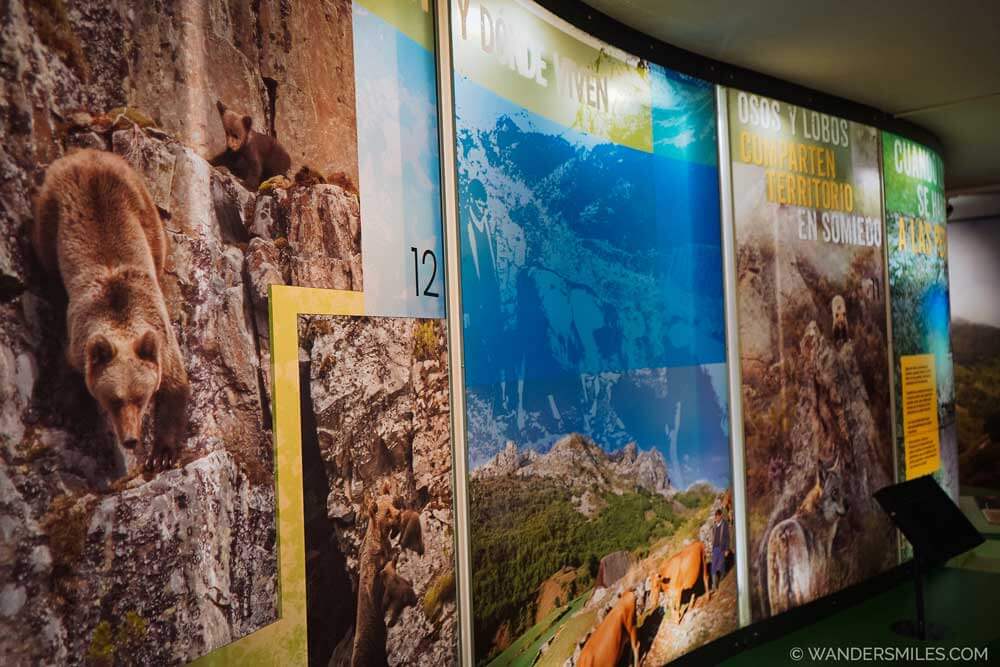
Run by the Fundación Oso Pardo, this centre is dedicated entirely to the Cantabrian brown bear. Through exhibits, videos, and engaging displays, you’ll learn about bear behaviour, their seasonal habits, and the conservation efforts that have helped their population slowly recover. It also offers insight into how bears coexist with local communities, which is an essential part of the region’s story.
|| CHECK BEAR INTERPRETATION CENTRE WEBSITE FOR EDUCATION AND VISITOR INFO
A Wild Brown Bear Experience Worth Waiting For
There are no guarantees when it comes to bear-watching in Somiedo, and that is exactly what makes it so exciting. You are out there scanning the hills, knowing a bear could appear at any moment. The best chances come at dawn and dusk, when guides sweep the mountainsides with spotting scopes, looking for the smallest sign of movement. Even without a sighting, there is something special about standing quietly in such a wild, untouched landscape.
And when you do see one, it is rarely close or dramatic. More often, it is a distant shape moving slowly across a hillside, completely unaware of you. But that brief moment, watching a wild bear going about its day, tends to stay with you long after the trip ends.
We had four bear-watching sessions and somehow got lucky every time. The first sighting was a lone male wandering along a cliffside about a kilometre away at La Peral. The next two were even further, where we spotted a mother and her two cubs playing, only visible through the scopes. Then came our final attempt, and it was unforgettable. A bear appeared much closer, moving through the valley, dipping into a stream, and climbing steadily up the mountainside right in front of us. It was like Bear TV!

|| FOR MORE SPAIN INSPO: YOU MAY LIKE TO READ ABOUT ZARAGOZA OR EXTREMADURA
Explore The Heritage Of Asturias
EcoMuseum in Veigas
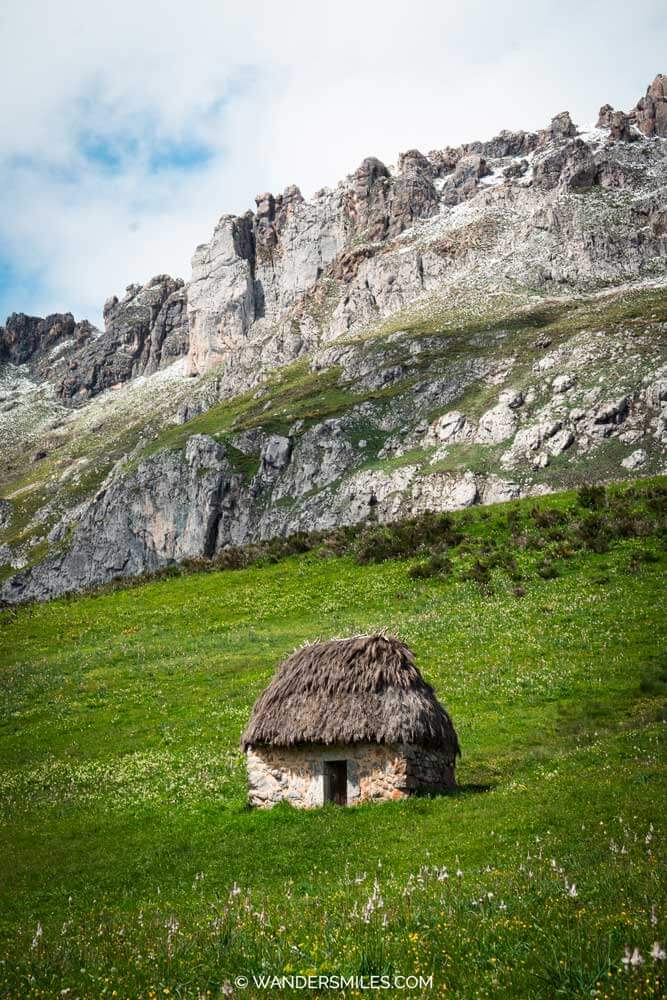
Set in the small village of Veigas, the EcoMuseum of Somiedo brings traditional mountain life into focus. It is a collection of restored ‘teito’ stone houses with thatched roofs that show how people once lived and worked in this remote landscape. Walking through the site, you see how daily life was closely tied to the land, from livestock farming to the seasonal movement between pastures.
- Teitos: Traditional, thatched-roof mountain cabins.
- Madreñas (traditional wooden clogs)


Traditional village Of Perlunes
Like many villages in the region, Perlunes was not built by chance but carefully placed to make life easier. In this case, it is water that defines the village. Streams run through the valley, and even though the sun barely reaches here in winter, the steady supply of water made it a practical and sustainable place to settle.
The village is spread across three small clusters, with stone houses stepping gently up the hillside. There are information boards written in Spanish, but keep in mind that only a handful of people live here year-round in this living museum. Walking through Perlunes, you can still see how water shaped daily life, with old systems once used for milling grain, washing, and irrigation.
- Streams running though the village
- Community stone wash house in Perlunes


Mount Naranco in Oviedo
Just outside Oviedo, Mount Naranco is home to some of the most important pre-Romanesque monuments in Spain. The two impressive buildings, Santa María del Naranco and San Miguel de Lillo, date back to the 9th century and are recognised as UNESCO World Heritage Sites. Their simple architecture reflects the early days of the Asturian Kingdom and offers a rare look at a style that exists almost nowhere else.
A short distance away stands the Sagrado Corazón de Jesús (Sacred Heart of Jesus), a large statue overlooking the city from the hilltop, inaugurated in 1950. Altogether, Mount Naranco is a must-visit in Oviedo, combining cultural heritage with panoramic views over the surrounding countryside.
- Iglesia de Santa María del Naranco
- El Cristo del Naranco
- San Miguel de Lillo


Explore Someido’s Hiking Trails
Lago del Valle
Lago del Valle is one of the most popular and rewarding hikes in Somiedo Natural Park, and for good reason. The trail is around 12km and leads you through open valleys, traditional brañas, and gentle mountain scenery before reaching the largest lake in Asturias. It is a relatively accessible route, making it a great option if you want a scenic hike without anything too technical.
The real highlight is arriving at the lake itself, set against a backdrop of rugged peaks and often completely still, reflecting the landscape around it. It is the most idyllic, peaceful picnic spot that will make you think you are in Switzerland, not a remote part of Asturias.
 Valle de Lago
- Lago de Valle (Lake of the Valley)
- Traditional teito thatched-roof hut
- Brown horse with a foal



La Malva Forest
La Malva Forest offers a completely different feel from Somiedo’s open mountain trails, with shaded paths winding through dense woodland. The area is best known for the 6.9 km Ruta de Castro, a popular and relatively easy hike.
The trail follows a rocky path through thick forest filled with holm oak, beech, and chestnut trees, along with native Cantabrian vegetation. As you walk, the landscape gradually opens up to reveal views over the Pigüeña valley, adding a nice contrast to the enclosed woodland sections. Keep an eye out along the way, as you can spot markings on trees left by brown bears passing through the area.
You will also pass the historic La Malva power station, built in 1917 as Asturias’ first major hydroelectric plant. It is still in operation today and offers guided visits, adding an unexpected industrial heritage element to what is otherwise a peaceful forest walk.

- Plaque for José Antonio Fernández Prieto
- Brown bear tree markings
- Fundación Oso Pardo conservationist looking at bear markings


Discover the Rugged Coast Of Asturias
San Esteban de Pravia & Mirador del Espíritu Santo
San Esteban de Pravia sits right on the Nalón estuary, just before it meets the sea, and you can still see hints of its past as Spain’s main coal port in the old cranes and loading bays along the waterfront. These days, it is much more laid-back, with a small marina, coastal walks, and a local feel. I recommend stopping for lunch at Gran Hotel Brillante, which is known for great seafood, local produce and views over the water.
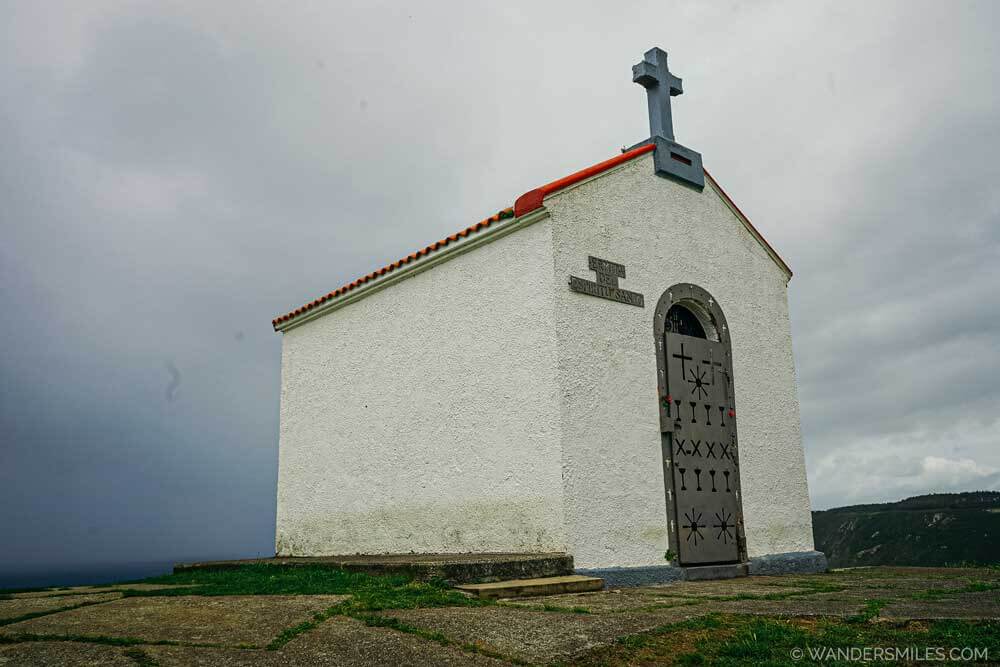
After lunch, head up to the Mirador del Espíritu Santo (Viewpoint of the Holy Spirit), just above the town. The views from here are seriously impressive, stretching along the coast from Cabo Peñas to Cabo Vidio and out over the mouth of the Nalón River.
It is part of a coastal walking route, so you can wander between viewpoints if you have time. Between the crashing waves of the Cantabrian Sea, the towering cliffs, and the Ermita del Espíritu Santo (Hermitage of the Holy Spirit), it is an easy highlight and a great way to experience Asturias’ coastline.
- San Esteban de Pravia Marina
- Mirador del Espíritu Santo
- Ermita del Espíritu Santo (Hermitage of the Holy Spirit),


Cabo Peñas
Cabo Peñas is the northernmost point of Asturias and one of its most dramatic coastal miradors, with cliffs rising around 100 metres above the Cantabrian Sea. Sitting right on the edge is the Cabo Peñas Lighthouse, first lit in 1852 and still guiding ships along this rugged coastline today. The surrounding headland is easy to explore on foot, with short paths and viewpoints that make the most of the cinematic scenery.
It is also a great place for wildlife. Cabo Peñas is a designated Special Protection Area for Birds, known for its seabird colonies and coastal species such as European shags, yellow-legged gulls, and peregrine falcons. The cliffs are a key vantage point for watching migration, and with a bit of luck, you might even spot dolphins offshore, which can be seen here throughout the year.

Birdwatching along the Villaviciosa Estuary
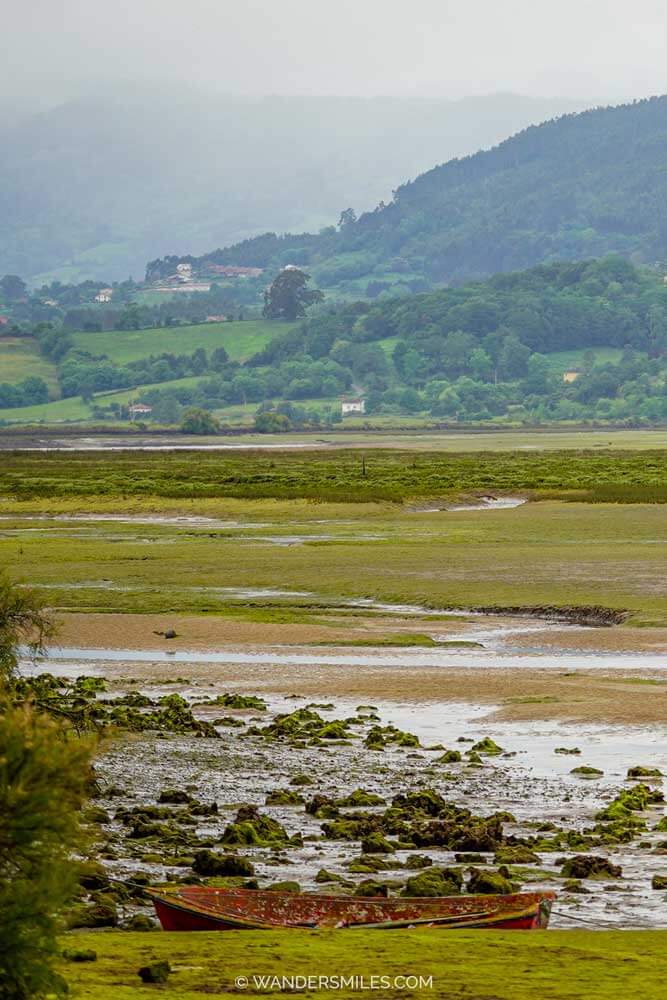
The Reserva Natural Parcial de la Ría de Villaviciosa is one of the best spots in northern Spain for birdwatching, especially if you’re into migratory species. Thanks to its mix of salt marshes, mudflats, and shallow water, it attracts a huge variety of birds throughout the year. Depending on when you visit, you might see waders like black-winged stilts picking through the mud, flocks of ducks resting on the water, or herons quietly hunting along the edges.
A great place to start is La Isla del Bornizal, where birdlife tends to gather, especially at low tide. Close by, the Observatorio de Aves de Salín is a well-placed hide that lets you watch everything without getting too close. It’s an easy, relaxed setup where you can just settle in and see what shows up. It is a lovely nature-led experience for both hardcore birders and those just wanting some ecotherapy.
- La Isla del Bornizal
- Black-winged stilt at Observatorio de Aves de Salín

Eat Your Way Through Asturias
Local Dishes You Have to Try
Asturian food is hearty, comforting, and deeply tied to the land. You’ll see classics like fabada, a rich bean stew with chorizo and morcilla, and pote asturiano, a similar but slightly lighter dish packed with greens and pork. In the mountains, these are the kind of meals that fuel long days outdoors.
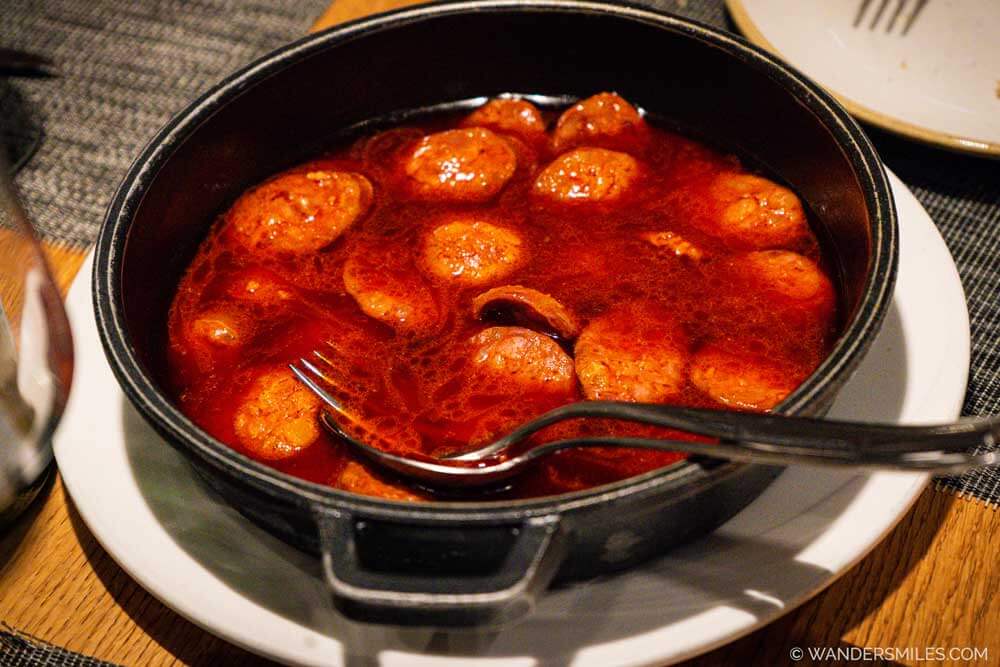
Cheese is a big deal here too, especially Cabrales, a strong blue cheese aged in natural caves in the Picos de Europa. Along the coast, seafood takes over, with fresh fish and shellfish appearing on most menus. For something a bit different, look out for carrilleras de ternera a la sidra, slow-cooked beef cheeks in cider that are that are rich and tender, or go for chorizo a la sidra, a simple but classic local favourite.
- Asturian Cheeses
- Chorizo a la sidra
- Sopa de Marisco
- Pote



Asturias, Spain’s Cider Capital
Asturias is famous for its cider, and trying it is part of the experience. Local cider, or sidra, is poured in a very particular way, with the bottle held high above the glass to aerate the drink. It might look theatrical, but it is all about releasing the flavour.
Cider houses, known as sidrerías, are everywhere, especially in Oviedo. They have an upbeat social atmosphere where drinks are shared and plates of food keep coming. It is less about a quick drink and more about settling in and enjoying the pace of Asturian life.

Handy Links for Bear Watching In Asturias
- Get train and flight times and prices to Oviedo
- Find the best hotels in Someido
- Find day trips and multiday tours on GetYourGuide or Viator
- Travel Insurance: 5% Off HeyMondo + Safetywing
PIN: 4 Days In Asturias – Bear Watching Trip


Thank you to Spain and Turismo Asturias for hosting my 4 days in Asturias focusing on brown bear watching in Somiedo Natural Park. All opinions are my own.
Disclosure: This post contains affiliate links, which means I may receive a small commission if you click a link and purchase something that I’ve recommended. It comes at no cost to you. Thank you for your support.