
One Day in Cordoba Spain: Andalusia’s Most Historic City
LAST UPDATED: 1st September 2026 | ORIGINAL: 29th August 2026
You can barely walk a few minutes in Córdoba without coming across another piece of history. Ancient bridges, winding lanes and magnificent architecture tell the story of the Roman, Islamic, Jewish and Christian influences that have shaped the city over the centuries.
If you are planning one day in Cordoba Spain, you will be pleased to know you can see plenty without spending the whole day racing from one attraction to the next. Right in the heart of Andalusia, Córdoba is best known for the extraordinary Mezquita-Catedral, its colourful flower-filled patios and its intriguing mix of cultures.
Compact and easy to explore on foot, Córdoba is perfect for a day trip or as part of a wider Spanish adventure. With so much culture and character crammed into its streets and along the Guadalquivir River, you will find plenty to fill a day.

Brief History Of Córdoba
Before visiting Córdoba, it helps to have a rough sense of the city’s timeline and how its mix of cultures became one of its greatest strengths. From its early Roman roots to its time as a major Islamic capital and later its years under Christian rule, every period helped mould the city of Córdoba you can explore today.
The story begins in the 2nd century BC, when the Romans established Córdoba as an important settlement in the Iberian Peninsula. Its location on the Guadalquivir River helped it develop into a prosperous and well-connected city, and traces of that Roman legacy can still be seen today, most notably in the famous Roman Bridge.
After the Romans came the Visigoths, and then in the 8th century Córdoba was taken by Muslim rulers. This was when the city really flourished. Under the Umayyads, Córdoba became the capital of Al-Andalus and, by the 10th century under the Caliphate of Córdoba, it had grown into one of the leading centres of culture, learning and power in Europe.
One of the best reminders of that period is the stunning Mezquita, which began as a mosque and was expanded over the years. Just outside the city, the ruins of Medina Azahara also show the scale and ambition of Córdoba during its most powerful days.
In 1236, Córdoba was captured by Christian forces during the Reconquista, starting another important chapter in its history. The Mezquita was turned into a cathedral, and over time Christian features were added, creating the unique Mezquita-Catedral that stands today. The Alcázar de los Reyes Cristianos also became an important royal base for Ferdinand and Isabella.
Córdoba also has an important connection to Spain’s Jewish history, especially in the old Jewish Quarter. The Córdoba Synagogue was built in 1315 in the Mudéjar style. After the Reconquista, the Alhambra Decree of 1492 forced Jews and Muslims in Spain to either convert to Christianity or leave the country. Many Sephardic Jewish families left for North Africa, the Ottoman Empire, Italy and Portugal.
Córdoba eventually lost much of its political importance, which ironically helped protect its historic character. Centuries later, recognition of this extraordinary heritage came with the historic centre being declared a UNESCO World Heritage Site in 1994, helping establish Córdoba as one of Spain’s most fascinating cultural destinations.

How I spent One Day in Córdoba
My own visit to Córdoba was part of a rail holiday with Great Rail Journeys exploring Spanish cities. The trip included travel between destinations, hotel accommodation and a guided walking tour of Córdoba, including the area around the Mezquita-Catedral. Once the tour wrapped up, I had the rest of the day to myself, and trust me, finding things to do was not a problem. Choosing the sustainable way to travel is always a good idea!
|| READ ABOUT THE FULL ICONIC CITIES OF SPAIN RAIL TRIP
Visit the Mezquita-Catedral
Before talking about anything else in Córdoba, the Mezquita-Catedral deserves special mention. It was absolutely stunning and easily one of the most memorable places I visited on the trip. Few buildings manage to feel quite so grand and historically significant all at once.
The Mezquita-Catedral was originally built as a mosque and once considered the largest Islamic mosque in Europe, its interior is filled with an astonishing forest of around 850 columns. Double-tiered arches stretch above them, creating the distinctive red-and-white pattern that has become synonymous with Córdoba.
As you wander further inside, the building keeps revealing something new. At the heart of the former mosque is the Mihrab, the sacred prayer niche facing towards Mecca, with its octagonal chamber decorated with intricate floral designs. Then, almost unexpectedly, the columns give way to a completely different sight: a Catholic cathedral rising from the middle of the former mosque. After Córdoba came back under Christian rule in the 13th century, the Mezquita was converted for Christian worship, but rather than replacing the entire structure, much of the original mosque was retained.
The result is an extraordinary building where mosque and cathedral exist side by side. It is this unusual combination that makes the Mezquita-Catedral so fascinating. Walking through it, you can see centuries of changing faiths, cultures and architectural influences in a single space, making it one of the most memorable experiences you can have during one day in Córdoba.
 Horseshoe red-and-white arches
- Renaissance and Baroque altar and dome system


Courtyards of Córdoba
The walking tour also took us through Córdoba’s famous patios, and it is easy to see why they are such a source of local pride. With more than 4,000 traditional courtyards across the city, many are filled with cascading flowers, luxuriant greenery and traditional ceramic details, creating beautiful shaded spaces hidden behind otherwise unassuming doorways.
Our guide summed up the importance of the patios with a line that still makes me laugh: “We don’t persecute you because of your religion. Just if your patio sucks.” It was a joke, of course, but it also showed just how seriously the people of Córdoba take this much-loved tradition.
If seeing the patios at their colourful best is high on your list, try to plan your trip around the Festival of the Courtyards (“Patios”) of Córdoba, held during the first two weeks of May each year. The festival was inscribed on UNESCO’s Intangible Cultural Heritage List in 2012, and during the celebrations, participating courtyards open their doors for visitors to admire their floral displays.
- Calleja de las Flores (Flower Alley)
- Traditional Andalusian tile courtyard


=> INTERESTED IN READING MORE ABOUT ANDALUCIA? Check out my blogs on Malaga, Antequera, Seville , Sierra Norte de Sevilla and tapas from Andalucia
Visit the Jewish Quarter
Another highlight was exploring Córdoba’s historic Jewish Quarter, or Judería, one of the city’s most characterful areas with its narrow cobblestone lanes and and whitewashed buildings.
If you are planning your Córdoba itinerary, it is worth checking opening times in advance, as a few of the main sights were closed on the day I visited. The Córdoba Synagogue is one of only three surviving pre-expulsion medieval synagogues in Spain and is especially notable for its Mudéjar-style design. Nearby, Casa de Sefarad explores Judeo-Spanish culture and traditions through a series of exhibitions.
I did get to visit Casa Andalusí, a restored 12th-century house that helps bring medieval Córdoba to life. It is a small museum with a columned courtyard, traditional Andalusian decoration and underground passageways. The museum includes an exhibit on traditional paper-making, as well as ancient coins and other medieval Roman and Moorish artefacts.

Cross the Bridges of Córdoba
One of my favourite ways to take in Córdoba was from the banks of the Guadalquivir River. I crossed the San Rafael Bridge, which opened in 1953 and provided a much-needed alternative to the city’s ancient crossing. Before it was built, the Roman Bridge had been Córdoba’s only bridge across the Guadalquivir for around 2,000 years. From San Rafael, you get a great perspective of the historic city and can really appreciate how much of Córdoba’s story is centred around the river.
Of course, no visit to Córdoba would be complete without walking across the Roman Bridge itself. Dating back to the 1st century BC, the bridge was built during Roman rule and has been rebuilt and altered many times throughout its long history. It stretches across the Guadalquivir for around 250 metres and consists of 16 arches, although much of what you see today dates from later restorations.

Visit Alcázar de los Reyes Cristianos
The Alcázar de los Reyes Cristianos is one of Córdoba’s most important historic landmarks, with a past that stretches back through Roman, Islamic and Christian rule. The fortress-palace was built in the 14th century on the site of an earlier Islamic fortress, and later became an important residence for the Christian monarchs. Christopher Columbus is also said to have met Queen Isabella and King Ferdinand here before his famous voyage to the Americas.
Visitors can explore the imposing stone fortress, climb the towers for views across Córdoba and wander through the beautiful gardens, where fountains, pools and neatly arranged terraces within the castle walls.
If you are visiting Córdoba in summer, check the opening times before you go, as the castle can close earlier during the hotter months. There is also the option of visiting at night on selected evenings, when the Alcázar is beautifully illuminated.
|| BOOK TICKETS FOR THE ALCÁZAR DE CÓRDOBA

Devour Andalusian Cuisine
Andalusian food naturally became part of the experience. Lunch at Taberna Rafaé was a bowl of salmorejo, Córdoba’s famous chilled tomato soup. Rich, smooth and refreshing, it was exactly the right dish after spending hours in the baking heat. Sometimes the simplest regional dishes end up being the most satisfying.
In the evening, we ate at Restaurante El Burlaero, tucked away in a small courtyard. It felt like a fitting place to end the day, with a relaxed setting and traditional dishes on the menu. Smoked sardines and grilled peppers made a delicious final meal before we headed back towards the river.
- Salmorejo in Taberna Rafaé
- Fried Anchovies in Tabernba Burlaero


Shop Artisan Souvenirs
Córdoba is famous for its grand monuments, but I also enjoyed discovering the city’s creative side. We stopped by a local leather workshop, where traditional techniques are still used to create handcrafted goods decorated with Córdoba-inspired designs. It was a chance to see the skill behind these products and appreciate the time and care that goes into keeping these crafts alive.
For an even bigger dose of local craftsmanship, head to the Municipal Zoco in the heart of the Jewish Quarter. This historic craft market is home to working workshops where leatherworkers, silversmiths and ceramicists create and sell their products. You can wander through the charming patios, watch artisans at work and, best of all, buy directly from the people who made the items.
Leather has long been one of Córdoba’s most famous crafts, particularly the traditional embossed designs known as cordobanes and guadamecíes. You will also find delicate silver filigree, colourful ceramics and plenty of jewellery inspired by the city’s Andalusian heritage. If you fancy taking home something a little more meaningful than the usual souvenir, this is a great place to pick up a piece of Córdoba.
 Cordoban embossed leather.
- Hand-painted plates


Sunset Cocktails
My day ended on the rooftop of the Hesperia Córdoba Hotel, cocktail in hand and the Mezquita-Catedral stretching out across the river below. As the sun began to set and the light slowly faded, it felt like the perfect way to round off our time in Córdoba.

FAQs for visiting Córdoba
Is one day In Cordoba Spain enough?
One day in Córdoba is definitely enough. The city is compact making it easy to see the major historical highlights like the Mezquita-Catedral, the Jewish Quarter and the Roman Bridge. Córdoba proves that even a short visit can feel full and rewarding.
Which is nicer, Cordoba or Granada?
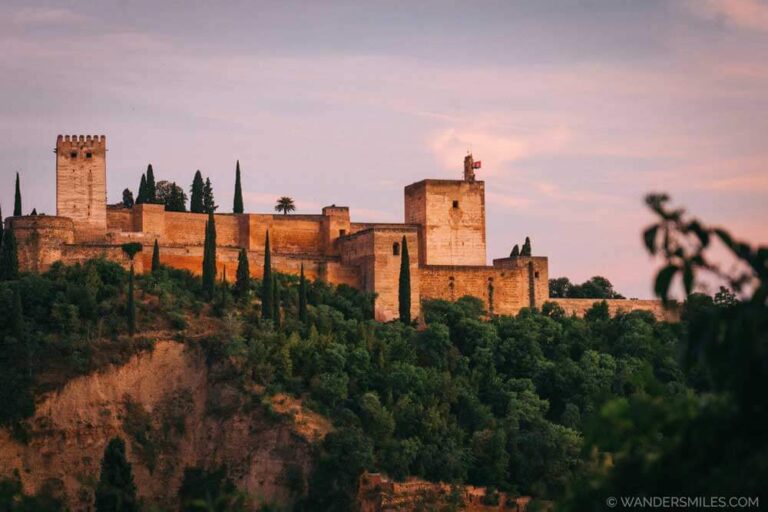
That really depends on what you are looking for. Granada has the spectacular Alhambra and a more dramatic, hillier setting, while Córdoba is more compact and easy to explore on foot, with the incredible Mezquita-Catedral, atmospheric Jewish Quarter and famous flower-filled patios. If you only have one day, I found Córdoba particularly easy to explore.
What is the best time of year to visit Córdoba?
Spring and autumn are generally the best times to visit Córdoba, when temperatures are more comfortable for wandering around the historic centre. May is particularly appealing if you want to see the famous patios bursting with flowers during the Festival of the Courtyards, although this is also a popular time to visit. Summer can be extremely hot, so plan sightseeing for the cooler mornings and evenings if you travel then.
Was Game of Thrones filmed in Cordoba?
Yes, Game of Thrones filmed scenes in Córdoba, with the Roman Bridge featuring in the series as part of the fictional city of Volantis. The bridge is one of Córdoba’s most recognisable landmarks, so fans of the show can add a little Westeros spotting to their visit.
Thank you to Great Rail Journeys for supporting my passion for train travel and giving me the opportunity to show my readers what it’s like to explore Spain by train with a group tour. As always, all opinions are my own.
PIN for One Day In Cordoba


Disclosure: This post contains affiliate links, which means I may receive a small commission if you click a link and purchase something that I’ve recommended. It comes at no cost to you. Thank you for your support.




I absolutely loved Cordoba and this is such a great guide for one day in the city!
THANK YOU! Always good to get confirmation from someone who has visited. I loved Cordoba too!