
16 Unmissable Things To Do In Malaga: A Different Side Of Costa del Sol
LAST UPDATED: 21st February 2026
Málaga isn’t just a sun-soaked stopover on the way to the Costa del Sol anymore — it’s become a city where culture lovers and foodies hang around. I found Roman ruins, Moorish fortresses, world-class art, traditional tapas tabernas, and sweeping Mediterranean views to keep me amused.
Curiously, Málaga balances old and new. You can saunter the medieval ramparts of Gibralfaro, step through the Moorish arches of the Alcazaba, and you’ll find a Roman theatre carved into the city’s foundations. Picasso’s legacy fills the museums while contemporary galleries and the murals of Lagunillas look forward.
After spending time exploring Andalucía, Málaga felt like the ideal spot to deliberately decelerate. Between the highlights, I took a jaunt though sub-tropical gardens, sipped sundowners on a rooftop, shopped at artisan markets, and lounged on golden sands where espestos crackled on the grill.
This guide pulls together my favourite things to do in Malaga, from hidden gems to those unmissable classics. If you’re still deciding on a weekend city break or tacking Malaga onto a longer Andalusian adventure, I hope this blog helps you plan your itinerary.

About Malaga
Where is Malaga?
Málaga sits on Spain’s southern Mediterranean coast in the region of Andalucía, about 100 kilometres east of Gibraltar. It’s the gateway to the Costa del Sol, with fast connections by train and plane making it an easy hop from Madrid, Barcelona, and many European cities.
Brief History of Malaga
Málaga is one of the oldest cities in Europe, founded by the Phoenicians around 800 BC and later shaped by the Romans, who built the amphitheatre that still stands today. The Moors arrived in the 8th century, leaving behind the Alcazaba fortress and Gibralfaro Castle that dominate the skyline. After the Christian Reconquest in 1487, grand churches and plazas were built.
Málaga’s history is evident throughout its streets, from ancient ruins to Moorish arches and Renaissance facades, there is over 2,800 years of fascinating settlement stories waiting to be heard.
Is Malaga Worth Visiting?
Yes, Málaga is worth visiting, particularly for travellers interested in history, culture, and gastronomy. It is the sixth-largest city in Spain and yet it doesn’t feel huge. One of the many pluses of Malaga is that you can explore most of its highlights on foot.
You get golden beaches and rooftop bars, but also Moorish palaces, Roman ruins, and museums that celebrate both Picasso and contemporary art. The food scene is a big highlight, from lively tapas tavernas to seafood fresh off the grill at beachside chiringuitos. If you’re searching for a city oozing with culture, history, and laid-back coastal living in a way that never feels overwhelming, Malaga is your place!
Uncovering The Best Of Malaga
On my mini-adventure in Andalusia by bus, I started Seville and worked my way to Malaga for some slow culture and tapas time, with a side of beach thrown in. Included in my blog, will be my tips on:
- activities in Malaga
- where to eat in Malaga
- where to stay in Malaga
- getting to Malaga
MY TOP TIPS`: If you’re planning a trip to Andalucia, consider spending 3 days in Seville, visiting Antquera and joining one of the Malaga tours to get a feel for the area.
Map of Malaga
I hope you find my map of Malaga a handy resource for planning your trip. It’s designed to help you navigate the best attractions, transport options, and restaurants with ease, so you can make the most of your visit.
|| CLICK FOR THE MAP OF MALAGA SPAIN

Historical Things To Do in Malaga
Visit the Alcazaba Of Malaga and Gibralfaro Castle
The Alcazaba of Malaga sits on the slopes of Mount Gibralfaro. The site was first occupied by the Phoenicians around 600 BC and later by the Romans. In the 8th century, it became a military fortress under Islamic rule, with later rulers expanding it into a palace.
Highlights include the Tower of Homage, the Plaza de Armas with its gardens, the Nasrid Palace with spacious courtyards. The Taifa Palace, has Moorish horseshoe arches with intricate stucco carvings that lead to open balconies overlooking the city, mountains, and port.
Above it is Gibralfaro Castle, added in the 14th century to protect the Alcazaba and linked to it by the fortified walkway known as the Coracha. Climb up to the castle and you’ll be rewarded with some of the best views in Malaga, stretching from the harbor to the mountains.
At its base you’ll also see the Roman Theatre, a reminder of how many cultures influenced the city. Exploring all three sites gives you a real sense of how important this hilltop is, and considered one of the best things to do in Malaga.
|| ALCAZABA OF MALAGA TOURS & TICKETS

Roman Theatre of Malaga
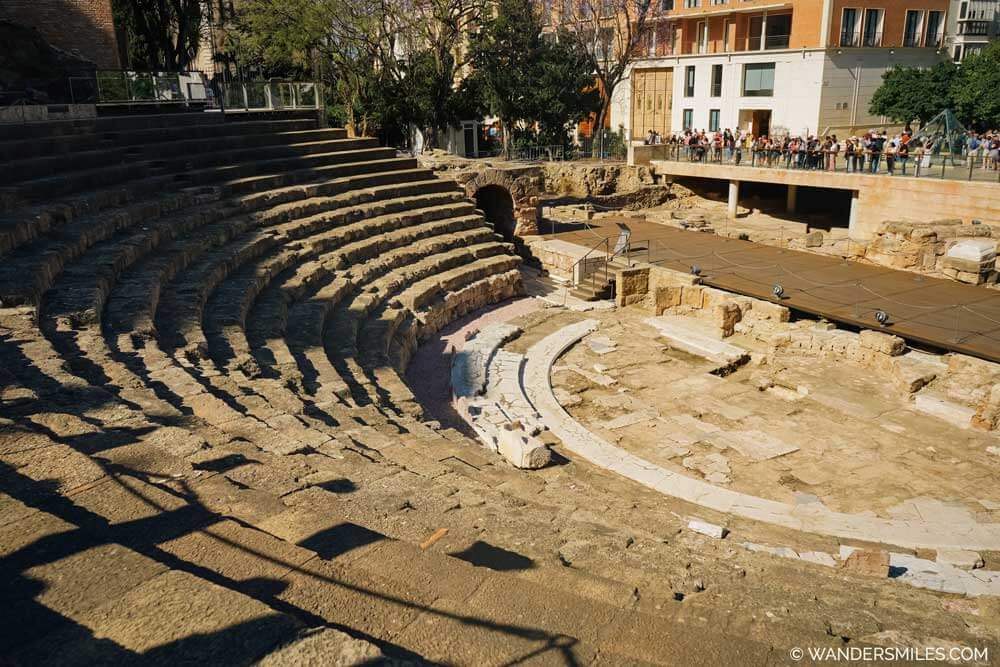
The Roman Theatre of Malaga was built in the 1st century BC, it’s one of the oldest landmarks in the city and a reminder that Malaga’s history stretches back over two millennia. Remarkably, it was only discovered in 1951 during the construction of the Casa de Cultura (House of Culture), having been buried under rubble for nearly five centuries.
I’d recommend taking a guided tour of Alcazaba and Roman Theatre with entry included. But if you want to tap into your inner history geek, there is a self-guided tour to explore the ancient history of Malaga.
Churches To See in Malaga City
Malaga Cathedral
The Malaga Cathedral, also known as La Manquita or “the one-armed lady,” is impossible to miss in the city centre thanks to its towering Renaissance façade and incomplete second tower. Construction began in the 16th century on the site of a former mosque, combining Gothic, Renaissance, and Baroque styles into a magnificent church.
When I wandered inside, I was immediately drawn to the soaring nave, intricate choir stalls carved from cedar, and beautifully detailed chapels and carved saints that make it one of Spain’s architectural highlights.
|| GRAB YOUR SKIP-THE-LINE TICKET FOR MALAGA CATHEDRAL

Sagrado Corazón Church
The Sacred Heart Church (iglesia del Sagrado Corazón) in Malaga shows a different side of the city’s religious architecture. Built in 1920 in a neo-Gothic style, it has pointed arches, stained-glass windows, and intricate details. Inside, the coloured light filters through the glass onto the altarpieces and sculptures, drawing attention to the fine craftsmanship.


Parroquia Santiago Apóstol Málaga
Visiting Parroquia Santiago Apóstol in Malaga takes you to the city’s oldest church, built in the 15th century on the site of a former mosque. It’s a fine example of Mudejar-Gothic architecture, with an elegant yet understated façade that blends into the busy Calle Granada. On the inside, the high vaulted ceilings and ornate gold altarpieces give it a sense of grandeur.
If you’re following Picasso’s story in Malaga, you’ll eventually come across the Church of Santiago Apóstol, where he was baptised in 1881.

Best Museums To Visit in Malaga
Explore the Picasso Trail
Born on October 25, 1881, Picasso spent his childhood in Malaga until the age of nine. He returned many times during his life, and the city still carries the imprint of Picasso and his family.
Start at Casa Natal Picasso, his birthplace turned museum, where you’ll find family keepsakes and some of his earliest sketches. In Plaza de la Merced, you can spot his life-size bronze statue sitting on a bench. From there, pass by the Church of Santiago Apóstol, where he was baptised, before ending at the Picasso Museum, home to more than 200 works that showcase the breadth of his creativity, from cubism to classicism.
That’s the simplified story, but around Malaga you’ll spot reminders of Picasso everywhere. The statues, plaques, buildings, and even the streets he once walked paint a picture of his life. You can see Colegio de San Rafael, where he went to school, and Ateneo de Málaga, once the San Telmo School of Fine Arts, where his father taught line drawing.
|| LEARN ABOUT PICASSO WITH MUSEUM TICKETS AND WALKING TOURS
 “The Face Of Peace” illustration in Museo Casa Natal de Picasso
- Picasso Museum


the Malaga Museum
The Malaga Museum is housed in the elegant 18th-century Palacio de la Aduana, a former customs house by the port that’s been beautifully restored. Its neoclassical façade hints at the treasures inside, where Malaga’s history and culture are on full display.
The museum is divided into archaeology and fine arts. The archaeology section takes you right back to prehistoric times, with artefacts from the Paleolithic, Mesolithic, and Neolithic eras, as well as Roman mosaics, ceramics, and Moorish treasures that trace Malaga’s evolution.
The art collection covers the 17th century through to modern works, including Picasso. One of my favourites was El Juicio de Paris (The Judgment of Paris) by Enrique Simonet y Lombardo, which places a classical myth in a Mediterranean setting.

Museo Revello de Toro
The Museo Revello de Toro is dedicated to the work of Félix Revello de Toro, a 20th-century Malaga-born artist known for his portraits and figurative paintings.
Housed in the former home of scupltor Pedro de Mena near the historic centre, the museum combines traditional architecture with bright, open gallery spaces that let the artwork breathe. The comprehensive collection of Revello de Toro’s work, displays family and intimate female portraits, as well as promotional posters for the traditional “Feria de Agosto” (August Fair).
 Feria de Agosto Poster
- “sumida en el sueño”


Centre Pompidou Málaga
Set in Malaga’s modern port area, Muelle Uno, the Centre Pompidou is instantly recognisable by its colourful glass cube entrance. El Cubo was designed by French artist Daniel Buren, and when you step inside, you’ll see how his clever design changes as the sunlight filters through the panels, casting vibrant colours across the space.
The museum showcases an impressive mix of modern and contemporary works on loan from the Pompidou in Paris, featuring artists such as Frida Kahlo, Francis Bacon and Marc Chagall. Alongside its permanent collection, it regularly hosts temporary exhibitions, so there’s always something new to discover. On my visit, I was lucky enough to catch a brilliant Wassily Kandinsky collection.
|| GRAB YOUR SKIP-THE-LINE TICKET FOR CENTRE POMPIDOU

Relaxing Things To Do in Malaga
Eat Tapas Every Day
One of the things I love most about Malaga is eating tapas every single day from locally-owned tapas bars. There’s nothing fancy about it — just simple dishes that let the ingredients speak for themselves. Just imagine seasonal vegetables, fresh seafood straight from the coast, and a glass of local Andalusian wine. I can never decide between the classics like patatas bravas and gambas pil pil (prawns in garlic and chilli) or something a little different like ajo blanco (white gazpacho with garlic and almonds) or berenjenas con miel (aubergine with honey).
I’ll happily pull up a stool at a bustling tapas taberna, order a few plates, sip on a cold vino, and call it a dreamy night. Some may say I’m low maintenance, but eating tapas just makes me happy!

Chill On Malaga’s Beaches
If you’re craving some downtime, Malaga’s beaches are perfect for it. La Malagueta Beach, just a short walk from the city centre, is the easiest spot to sink your toes in the sand, grab a sun lounger, and take a dip between sightseeing stops. For a more tranquil playa, head east to Pedregalejo, an old fishing neighbourhood with a more local feel. Whichever you choose, you’ll find plenty of chiringuitos serving fresh grilled sardines right on the shore.

Wander Through Parque de Malaga
Málaga Park, also known as Paseo del Parque, is the city’s green oasis and considered one of the most important subtropical gardens in Europe. Built in the late 19th century on land reclaimed from the sea, it was part of a project to expand the port. Planting began in 1899, and today the park covers 30,000 square metres with more than 350 plant species from five continents, from Mexican fan palms and Madagascan screwpines to Australian ficus trees. There is information on the flora for the green-fingered visitors!
The park isn’t just about nature. Scattered among its shaded paths are 19th-century fountains, sculptures, and monuments, like the Fountain of the Three Graces and the Nymph with a Seashell. There’s also the Eduardo Ocón auditorium, still used for concerts and festivals. I was happy to make a pitstop under the jacarandas after the alcazaba tour on my way to Centre Pompidou.

Time For Retail Therapy
If you feel like mixing sightseeing with a little retail therapy, Málaga has bags of it! Calle Larios is Málaga’s best-known shopping street, framed by elegant 19th-century buildings and filled with international brands alongside Spanish labels. It’s not exactly my scene for shopping, but I’d still recommend a walk here to enjoy the lively atmosphere, and to treat yourself to an ice cream from the fun Casa Mira.
I gravitate more towards browsing local artisan goods than chain stores. Málaga has many pop-up markets showcasing handmade crafts, unique designs, and regional flavours. The Made in Soho market gathers independent makers in a creative district, while El Zoco de Muelle Uno is perfect for shopping by the waterfront. I came away with a pair of delicate silver earrings and a natural cork wallet, and I was tempted by beautifully made artisan beachwear.
If food is more your thing, the Guadalhorce Ecological Market in Parque de Huelin is perfect for picking up fresh produce straight from local farmers. Atarazanas Market is a historic building, once a Moorish shipyard, now buzzes with stalls selling fresh produce, seafood, meats, and spices.

Indulge in Rooftop Cocktails
I admit I was more tempted by tapas bars than cocktails, but I couldn’t leave Málaga without trying at least one rooftop. I chose La Terraza de Valeria, where the views stretch across the port and the mountains beyond. Visiting in the daytim,e the vibe was relaxed, and it came with an unexpected guests. A few harmless Eurasian collared doves swooped in whenever the waiter brought over nuts.
If you’re chasing more rooftop views, you’ve got options. Lolita Skyview extends a similar outlook over the port, while La Terraza de Larios and Molina Lario give you prime seats to admire the cathedral.

Check Out Malaga’s Street Art
Malaga isn’t just Picasso’s hometown; the city is a creative outdoor gallery. The trendy SOHO district, or Barrio de las Artes, is widely known as the birthplace of the city’s street art scene thanks to the MAUS project, with monochrome animal murals by ROA tumbling down the walls and works by D Face and Shepard Fairey spilling onto the banks of the River Guadalmedina.
Street art lovers must venture into the alleyways of Lagunillas, where much of the art was born from locals’ frustration at their neighbourhood being neglected. Artists like Doger, Lalone and Elafil have breathed new life into abandoned walls with creative pieces.
|| TAKE A STREET ART TOUR IN SOHO MALAGA


Take a day trip from Malaga
One of the best things about basing yourself in Malaga is how many incredible destinations are just a short journey away. It’s worth adding extra time to your itinerary to explore the region.
Ronda, sits dramatically above a deep gorge and is perfect for wandering cobbled streets, exploring historic bridges, and soaking in epic views. Adventure lovers will want to tackle the Caminito del Rey, a thrilling walkway clinging to the walls of a narrow gorge. If history is more your thing, Antequera has centuries-old churches, prehistoric dolmens, and the surreal limestone landscapes of El Torcal.
For a trip along the coast, Nerja delivers sandy coves, crystal-clear waters, and the impressive Nerja Caves. If you don’t mind a longer trip, Granada is well worth the journey to see the breathtaking Alhambra, stroll the Albaicín’s winding lanes, and sample authentic Andalusian tapas.
|| CHECK OUT DAY TRIPS FROM MALAGA

Plan Your Malaga Trip
How to Reach Malaga
Malaga is easy to reach thanks to its well-connected transport links. Málaga-Costa del Sol Airport (AGP), just 8km from the city centre, has frequent flights from across Europe and beyond, with a quick train, bus, or taxi ride into town.
If you’re coming from elsewhere in Spain, high-speed AVE trains connect Malaga to Madrid in about 2.5 hours and to Seville in under two hours, while regional buses link it to coastal towns and Andalusian cities.
I travelled by bus around Andalucía — the services were frequent, reliable, and made getting between cities easy.
Where to Stay in Malaga
Malaga has a great selection of hotels and accommodation that is close to all the amenities, and will suit all budgets. I went for the cheaper end of the scale so I could spend my money on the tapas scene!
BUDGET | TOC Hostel Malaga is centrally-located. The decor is stylish comfortable with doms and private rooms. BUENO Café serves a fabulous breakfast with speciality roasted coffee — and they do yummy cakes too!
AFFORDABLE | Soho Boutique Urban is a 3 star hotel near the port of Malaga, with option of breakfast. Soho Hotels have LEED, Green Key, Ecostars and Bioscore certifications and get involved with community and volunteer programs.
LUXURY | Vincci Selección Posada del Patio is a 5 star with a chic design, restaurant and swimming pool. Vincci Hotels have green credentials and contribute to non-profit projects.
|| CLICK FOR MORE MALAGA HOTEL INSPIRATION
Best Time to Visit Malaga
The best time to visit Malaga is in spring (April to early June) or autumn (September to October) when the weather is warm but not sweltering, the sea is pleasant for swimming, and the city is less crowded than in peak summer. These seasons are perfect for exploring the historic centre, hiking nearby trails, and enjoying local festivals without battling intense heat or high-season prices.
How Long Do You Need In Malaga
For most travellers, two to three days in Malaga is enough to explore the city’s highlights without rushing. You can easily include the Alcazaba, Picasso Museum, cathedral, markets, and beach time in a long weekend. If you want to add day trips to places like Ronda, Nerja, Antequera or the Caminito del Rey, aim for four to five days to balance sightseeing with relaxed evenings at tapas bars. Malaga’s compact centre makes it easy to see a lot in a short time, but giving yourself an extra day or two lets you enjoy the slower pace that locals love.
Handy Links for Malaga
- Get train times and prices
- Compare flight prices to Malaga
- Find the best hotels in Malaga
- Get incredible car hire comparison quotes
- Find day trips and multiday tours on GetYourGuide or Viator
- Travel Insurance: 5% Off HeyMondo or 5% Off IATA
PIN for your Malaga trip


Disclosure: This post contains affiliate links, which means I may receive a small commission if you click a link and purchase something that I’ve recommended. It comes at no cost to you. Thank you for your support.





I’ve visited Malaga several times and even spent over a week there taking Spanish classes, which made me fall in love with the city even more. Your list brings back great memories of exploring the Alcazaba, wandering through the parks, and enjoying tapas in the evenings. I really appreciate the mix of historical and modern spots you’ve highlighted, and your photos are absolutely amazing. They capture the vibrant spirit of Malaga perfectly!
I met a few people doing language classes in Malaga. I’m glad my blog brought back happy mamemories of the wonderful things to do in Malaga.
We were just discussing a trip to Malaga, so this is very timely. Is it worth visiting Malaga in Winter, despite it not being swimming weather?
Visiting Malaga in the winter months would be a pleasant experience — no stifling heat to hike, or see the sights!