
8 Beautiful Villages Of Cyprus You Need to Explore
LAST UPDATED: 22nd December 2025 | ORIGINAL: 10th December 2025
Cyprus isn’t only about sun-drenched beaches and ancient ruins. The villages of Cyprus are hugged by mountains and full of living heritage, waiting for you to discover.
If you feel like you’re missing the island’s deeper stories, the villages of Cyprus are where you’ll find them. These rural communities still practise centuries-old crafts, from lace and weaving to pottery and frescoed churches. Cypriot traditions go beyond handicrafts, with local climate and historical influences shaping unique culinary customs that are firmly established into everyday life.
These villages offer far more than yawning valleys and staggering mountain views. By meandering around stoney lanes that have changed little over generations, you can connect with Cyprus in a way that’s harder to experience in the main tourist hotspots.
Here’s my pick of some of the most beautiful villages of Cyprus to explore on your next visit, along with practical ways to reach them.
How To Visit The Villages of Cyprus
Cyprus Village Tours
If you prefer someone else to handle the planning, guided Cyprus village tours make things easy. You can join small groups with options that focus on food, wine, crafts, or history. It’s a simple way to see several villages in one day while learning from local guides who know the stories behind each stop.
- From Paphos: Troodos Mountains & Villages Guided Day Trip
- From Paphos: Chrysoroyiatissa, Kykkos and Omodos Day Trip
- From Limassol: Best of Troodos Mountains & Villages
- From Larnaca: Grand Tour Jeep Safari
Self-Guided Cyprus Villages Trip
You can reach many of the villages by bus, but it takes a little more planning. Timetables can change with the season for rural areas, so always check return journeys before you set off. You can find the bus operators for each region on the Motion website.
Hiring a car gives you the freedom to explore on your own terms. Familiarise yourself with the island by moving between villages on scenic detours, and staying longer wherever you feel a connection. The roads are straightforward and having your own set of wheels lets you mould the trip into exactly the experience you want.
|| CLICK TO FIND THE BEST DEAL FOR CAR HIRE
Villages of Cyprus Map
You’ll find a handy map of must-visit Cyprus villages below. I haven’t made it to every one of them yet, but I’ve spent plenty of time researching the most interesting Cypriot sites for culture and easy exploring. Use it to carve out your own village-hopping road trip — just pick out a few favourites to discover a different side of the island.
|| CLICK TO SEE THE MAP OF CYPRUS VILLAGES

Cyprus Villages You Must Visit
Lefkara, Larnaca District
Lefkara is one of the best places in Cyprus to experience traditional craftsmanship up close. The village is known across the island for its fine lacework, called lefkaritika, and for its delicate filigree silver designs. Its name comes from the Greek words lefka (white) and ori (hills), inspired by the pale limestone cliffs of the Troodos Mountains that frame the village. The setting alone gives you a sense of place before you even start exploring.
As you wander through Lefkara, lace hangs outside many shopfronts, catching your eye straight away. This craft has been practised for centuries and is now recognised on the UNESCO Intangible Heritage list. Fewer young people are learning the skill today, but you can still see older women stitching geometric patterns by hand, often seated outside their homes.
Make time for the Museum of Traditional Embroidery and Silversmithing inside the 19th-century House of Patsalos. The Lefkara Handicraft Centre and small workshops, including Rouvis Lace and Silver, invite a closer look at how they are preserving their craft. Artisans are usually happy to talk about their work and explain how each piece comes to life.
Lefkara is quite a bustling village with lots of family-run cafes and shops to amble around. Traditional stone houses and quiet lanes draped in bougainvillea create an easy atmosphere. Visit the Church of the Holy Cross, explore the smaller chapels nearby, and seek out the recently restored Hamidiye Mosque, which back to the Ottoman Empire era.
 Lefkaritika lacemaking in Lefkara Village
 Cafe in Lefkara
- Filigree Silversmith
- Painted blue houses


Omodos, Limassol District
Omodos rises high in the mountains of the Limassol district and sits at the centre of one of Cyprus’s key wine regions. The main square has a buzzy feel, and the narrow lanes around it are filled with reminders of the village’s winemaking past. As you explore, you’ll come across glasswork studios, small shops selling woven textiles, and makers creating pipilla, the delicate narrow-knit lace unique to the area.
The Timios Stavros Monastery, known as the Holy Cross Monastery, is the village’s defining landmark. Venture into its courtyard to see the stone arches, old icons, and fine wood-carvings that show how long the monastery has been central to the community. Just a short walk away, you can visit Linos tou Charilaou, a medieval wine press that has been turned into a small museum.
Food and wine are part of the pleasure of visiting Omodos. Grab a table at a taverna where local produce takes centre stage. Katoi Taverna was a highlight for me, filled with the aroma of Cypriot meze and a hint of zivania. Don’t leave without trying arkatena, a circular bread made using fermented chickpea foam. Arkatena Fotini and George’s Bakery are two good places to taste it fresh.
If you love wine trails, give yourself time to head into the vineyards just outside the village. An late afternoon visit to Ktima Gerolemo is especially memorable, with warm light falling across the vines as the sun sinks behind the Troodos peaks. This wannabe oenophile left with new knowledge, a couple of bottles of Maratheftiko and Spourtiko, and the sense that Omodos is made for nature-led travellers who appreciate Cypriot culture and good wine.
- Katoi Tavern in Omodos
- Alleyway in Omodos, Cyprus
- Ktima Gerolemo Winery in Omodos
- Dempsi Glassmakers in Omodos


Lania (Laneia), Limassol District
Artists love Lania, and you see why as you meander through its quiet, bougainvillea-filled streets. Many homes open their doors during the annual Lania Art Festival in October, along with small community events run by the Women of Lania. Even on an ordinary day, you stumble across stone-built studios and sculptures tucked into painted courtyards. It’s no surprise Lania earned a place on the Colourful Villages of Cyprus list.
Joining a mosaic workshop with artist Antonis Rizopoulos is a lovely way to slow down and tap into Lania’s creative energy. Mosaics are a major part of Cyprus’s heritage, from the ancient floors of Paphos and Kourion to early Christian and Byzantine works in Larnaca. We worked on a modern fish design, and I can safely say it was nowhere near the level of the 4th-century fish mosaic in the House of Eustolios at Kourion, but still a fun way to connect with the island’s past while creating something of our own.
One fun detail in Lania is the trail of snail statues hidden on window ledges, rooftops, and shaded corners. It turns a simple stroll into a gentle treasure hunt. Pop your head inside the little cobbler’s museum where old photographs line the walls, or look around the traditional olive press and old winery with its massive pitharia jars that once stored wine and oil.
Make time to visit the Church of Panagia Eleousa, housing the miraculous icon of Panagia of Valana, and shiny gold chandeliers, and vivid painted murals. Lania is one of my favourite villages of Cyprus. It feels unhurried, perfect if you enjoy photography and mindful moseying.
- Church of Panagia Eleousa
- Ceramic snails
- Mosaic workshop in Lania
- Shoemaker Museum in Lania


Pelendri, Limassol District
The village of Pelendri spreads across gentle slopes of the Troodos Mountains dotted with stone houses and tranquil alleyways. It known for one of Cyprus’s most important painted churches: Timiou Stavrou. This UNESCO-listed monument holds vivid 12th- to 14th-century frescoes that give you a close look at Byzantine religious art. The apse preserves fragments dating back to 1171–1172, and later additions brought in more detailed wall paintings. You can easily pass the time inside, studying the colours and storytelling across the walls.
Surrounded by nature, Pelendri sits in one of Cyprus’s key wine-growing areas. Nearby vineyards produce excellent bottles, especially from the native Mavro and Xynisteri grapes, famously used together to produce Commandaria. You can visit Tsiakkas Winery to learn more about these varieties and taste how well they adapt to the cooler mountain climate.
The village is also known for its wild mushrooms, and the best place to try them is the family-run Symposio Tavern. The menu blends traditional Cypriot dishes with the usual meze favourites, alongside Italian-influenced plates such as makarónia tou foúrnou (Cypriot pasta bake). Everything is cooked with organic, local produce, letting the flavours of the region shine. The boiled halloumi with mint just melted in my mouth definitely needs a special mention though.


Tochni, Larnaca District
Tochni is one of the oldest villages on the island and works well as a base if you’re exploring the south of Cyprus. If you’re into the outdoors, you’ll love how quickly you can get from your doorstep to quiet cycling and hiking routes that wind through farmland and gentle hills.
The village has a distinct look thanks to the lightly coloured local Tochni stone used in its houses. In the centre, the Church of Saints Constantine and Helen sits perched on top of a bridge, and the small ecclesiastical museum nearby displays Orthodox relics and sacred objects worth a peek.
A lot of the older homes have been restored and turned into guesthouses, which gives the village an easy agrotourism rhythm. I joined a cooking workshop at Tochni Tavern, kneading eliopita (olive bread) and filling gemista (stuffed peppers and tomatoes), before settling in for a long meze lunch with homemade dishes and local wine arriving in steady flow.
- Tochni village
- Church of Saints Constantine and Helen
- Pottery figures at Tochni Tavern
- Gemista (stuffed peppers and tomatoes)


Fyti, Paphos District
Fyti is the weaving heart of the Paphos region and you sense it the moment you arrive. This small village is known for Fythkiotika, the colourful geometric textiles produced here since medieval times and now recognised as UNESCO Intangible Heritage.
The main workshop is full of life and hospitality as women work on their looms. Watching them throw the shuttle through and the patterns grow thread by thread gives the craft a new depth, and you can even try a few simple steps yourself. Visit the Fyti Weaving Museum to see historic looms and beautifully preserved pieces. The family who run it are generous with stories, and the museum displays old photos and tools that reflect generations of agricultural and textile traditions.
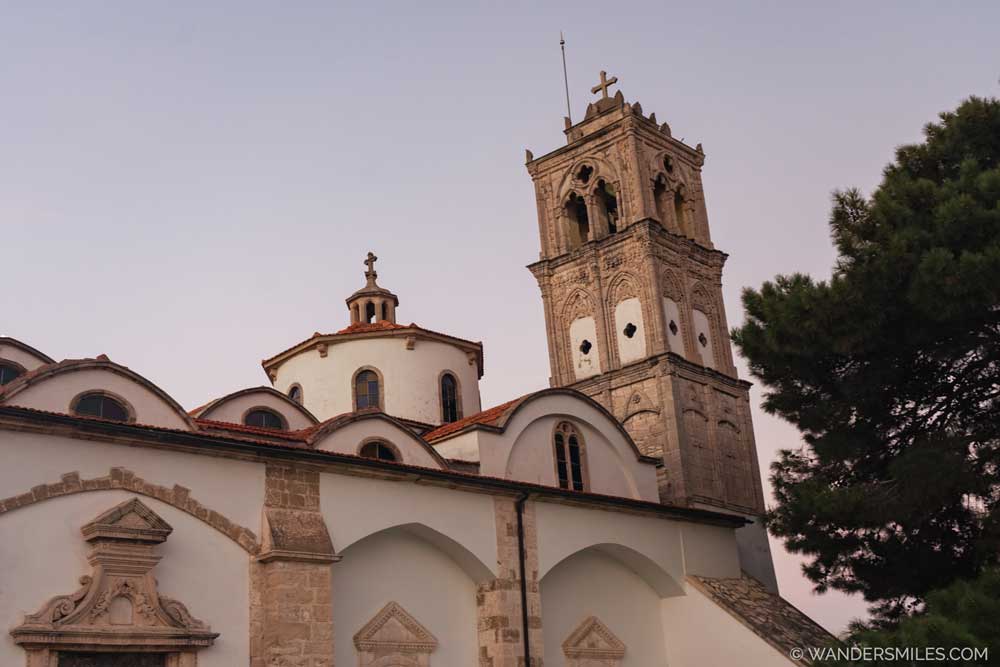
Some stone houses stand abandoned, yet the 800-year-old oak tree has stood the test of time. The central square is framed by the 19th-century Agios Demetrios Church, known for its carved wooden screen and a bell tower that rises well above the roofline.
Fyti is also a great stop if you want to support local makers. You can buy tablecloths, wall hangings, and woven textiles directly from the people who created them, pieces with real history rather than anything mass-produced.


Pissouri, Limassol District
Pissouri sits on a hillside between Limassol and Paphos, with an old village centre that still feels lived-in and local. You wander narrow lanes lined with whitewashed homes and family-run businesses. The aroma of grilling meat drifting from O’Vrakas Taverna is hard to ignore, and before you know it, you’re enjoying another round of meze made with ingredients sourced locally from Cyprus’s “region of plenty.”
If you like getting out on foot, Pissouri is a great starting point. Trails wind through vineyards and farmland, and you can walk up to viewpoints where the coastline spreads out below you. The village is only a short hop from Pissouri Bay, home to larger resorts, so it’s easy to split your day between quiet village life and time by the sea.
Visit in summer and you might catch “Sultanina’s Dance,” a lively annual celebration of the local grape variety. It’s a chance to see how proud the community is of its farming traditions. Pissouri offers simple pleasures and a grounded slice of Cypriot life.


Fikardou (Phicardou), Nicosia District
Fikardou feels like a village paused in another century, which makes it an interesting stop if you’re drawn to heritage and old-world architecture. Walk gingerly along uneven cobbles, look up at the wooden balconies, and notice the small details that have survived for generations in this traditional mountain settlement.
Protected as an ‘Ancient Monument‘, many of the low, timeworn houses date back to the 18th century and still hold their original character. Two of them, the House of Katsinioros and the House of Achilleas Dimitris, have been restored and now work as small museums to showcase how traditional family life may have looked, with rural tools and Cypriot wine pressing machine.
Fikardou stays peaceful for most of the year with very little inhabitants, but it transforms during the Christmas Holidays. The village becomes one of Cyprus’s official Christmas Villages, with twinkling pop-up stalls selling local produce and handicrafts. Some abandoned houses turn into cave-like shops run by nearby wineries. It’s the one moment when this almost-deserted outpost fills with people again, and it feels genuinely special.
|| YOU MAY LIKE TO READ WHY VISIT CYPRUS IN WINTER

Cyprus Trip Planning Resources
- Explore Cyprus destinations with Jet2Holidays
- Private and group tours with Get Your Guide and Viator
- Travel Insurance: 5% Off HeyMondo + Safetywing
PIN To Visit the Villages Of Cyprus


Disclosure: This post contains affiliate links, which means I may receive a small commission if you click a link and purchase something that I’ve recommended. It comes at no cost to you. Thank you for your support.




A wonderful and inspiring read. I have wanted to visit Cyprus for some time, and learn more about its history, and cuisine. This is a great introduction.
Fabulous news! I hope you can experience the Cypriot hospitality very soon.
Lefkara is one of our favorite villages in Cyprus. Not only is it beautiful, but watching those making the lace, silver, and even Cyprus Delights was truly a special experience.
Lefkara is a lovely village in Cyprus. I was fascinated visiting the workshops of the silversmiths and lacemakers.
All these places are so dreamy! Anytime I hear mountains, I am there.
Omodos will be my first stop :). Thanks for sharing.
You’re welcome. I’m glad you enjoyed reading about the villages of Cyprus. Omodos is a great choice!
Cyprus looks stunning. I love the architecture, history, and quaintness of the villages. Thanks for such a thorough review and post.
Cyprus is a beautiful island with many serene nature spots and villages to explore.
Lovely list! I would love to explore this area… and all the historic areas. And your photos are beautiful!
Thank you! Glad you like the rundown of what to do in Limassol in 24 hours (and longer) if you have the time.