3 Days in Seville: Map + Best Itinerary For First-Timers
LAST UPDATED: 21st February 2026
Planning your first trip to Seville can feel overwhelming, especially in a place as bursting in history and culture as Seville. Every guide promises the “must-sees”, but few tell you how to actually fit them into a realistic 3 days in Seville itinerary.
From the iconic Seville Cathedral and Giralda Tower to the stunning Real Alcázar and Plaza de España, there’s a lot to see in just a few days. Many first-timers in Seville struggle with fitting everything in and knowing where to start. Timed tickets at major attractions can sell out and it’s easy to spend half a day queueing instead of exploring.
You might worry about missing key landmarks, getting lost in the maze-like streets of Barrio Santa Cruz, or not having time to enjoy local experiences like tapas tasting and flamenco shows. With three days in Seville, you want an itinerary that balances sightseeing, food, and cultural immersion while leaving room for relaxed exploration.
With years of travel planning experience, I’ve mapped out a three-day plan that lets you experience Seville fully and efficiently. This guide is written for first-time visitors who want practical tips, and easy-to-follow routes. Whether you’re wandering palaces, exploring museums, or strolling through vibrant neighbourhoods, you’ll get the most out of your Seville visit without the stress, all while enjoying the city like a local.
How To Plan Your 3 Days in Seville Itinerary
How many Days Do You Need In Seville?
Three days in Seville is the sweet spot for a first visit. That gives you enough time to see the headline sights without rushing between them in the heat. You can also leave space for long tapas lunches, evening walks, and a flamenco show, which are just as much a part of the experience as the monuments.
If you only have two days, it’s still doable, but you’ll need to prioritise and book tickets carefully. Four to five days in Seville would be a dream so you add a nature visit to the Sierra Norte de Sevilla.
The Best 3 Days in Seville Itinerary
Day One — Classic Seville
Begin with a free walking tour to get your bearings and understand the city’s layered history. Afterwards, visit Seville Cathedral and climb Giralda Tower (book ahead). Later, wander around Plaza de España and relax in Parque de María Luisa. Spend the evening exploring the tapas scene, either independently or on a guided food tour.
Day Two — Culture & Neighbourhoods
Start at Museo de Bellas Artes de Sevilla, then visit the Flamenco Museum to learn about Andalusia’s most iconic art form. Head underground to Antiquarium before wandering through Barrio Santa Cruz. In the afternoon, explore Real Alcázar of Seville and end the day with a live flamenco show.
Day Three — Palaces & River Views
Visit Casa de Pilatos and Palacio de las Dueñas for a glimpse into noble life. Later, enjoy a riverside walk or boat trip along the Guadalquivir. Finish your trip at Metropol Parasol, timing your visit for sunset and the evening light show.
Seville City Guide Map
Although I couldn’t visit everything on my must-see list in my Seville city guide due to limited time, I’m excited to share my research to help you plan your own trip. I hope this map of things to do in Seville proves to be a handy resource for you to navigate the city easily.
Quick Links for Seville Trip Planning
- Discover FREE walking tours with locals
- Find the best day tours in Seville
- Explore hassle-free, multi-day private and group tours
- Find great deals on affordable hotels and quirky hostels
Need To Know For Seville
- Currency: Euro
- Language: Spanish. Learn a few basic phrases just in case.
- Climate: Hot summers, pleasant winter temperatures
- Tipping: Around 10% is fine, although not expected.
Unmissable Things To Do In Seville On Your First Visit
Take A Free Walking Tour of Seville
A free walking tour is one of the best ways to get oriented in Seville, especially if it’s your first visit. Led by knowledgeable local guides, these tours typically cover the city’s most important landmarks while sharing fascinating stories about Seville’s Roman, Moorish, Jewish, and Christian past. You’ll stroll through historic neighbourhoods like El Arenal and Barrio Santa Cruz, learn the legends behind Seville Cathedral, and discover nooks and crannies of the city you might otherwise miss.
What makes these tours special is the storytelling. The guides often combine history with humour, local traditions, and personal insights into Sevillian life. You can pick their brains for practical tips on where to eat tapas and which attractions are worth your time. Although the tours are technically “free,” tipping the going rate is customary and well deserved for guides that make it an engaging introduction to the Seville.
|| BOOK A FREE WALKING TOUR IN SEVILLE
 Barrio Santa Cruz (Jewish Quarter) in Seville
- Views of Giralda Tower in Seville


Explore The Real Alcázar of Seville
The Real Alcázar of Seville is one of the most spectacular royal palaces in Europe and a true highlight of the city. Still used by the Spanish royal family, this UNESCO World Heritage Site showcases exquisite Mudéjar architecture, a fusion of Islamic design with Christian influences. As I meandered through the historic rooms, I was aghast at the level of detail in the azulejo tilework, carved wooden doorframes, and coffered ceilings. The Courtyard of the Maidens (Patio de las Doncellas) is a glorious example of an Islamic inner courtyard, centred around a long sunken pool.
The palace gardens are just as impressive as the interiors. Towering palm trees shading walkways and ornate fountains, and peacocks strut freely among fragrant orange trees. For the GOT fans, you may even recognise parts of the gardens as the Real Alcázar famously doubled as a filming location for Game of Thrones.
Allow plenty of time to explore both the palace and the gardens if you want to make the most of your visit. Booking tickets in advance is essential, particularly during peak seasons, as queues can be long and time inside is far too precious to waste waiting outside.
|| BOOK TICKETS & TOURS AT REAL ALCÁZAR OF SEVILLE
- Patio de las Doncellas at Royal Alcazar of Seville
- Gardens of Royal Alcazar of Seville


Visit Seville Cathedral & Giralda Tower
Seville Cathedral is an awe-inspiring monument built on the site of a former mosque and is the largest Gothic cathedral in the world. Its vast interior is filled with soaring arches, gilded altarpieces, and countless chapels. One of the cathedral’s most famous features is the tomb of Christopher Columbus, giving the site major historical significance. Do not miss the Sala Capitular (Chapter House), a beautifully proportioned Renaissance space crowned by a domed ceiling and known for its remarkable acoustics and exquisite decoration.
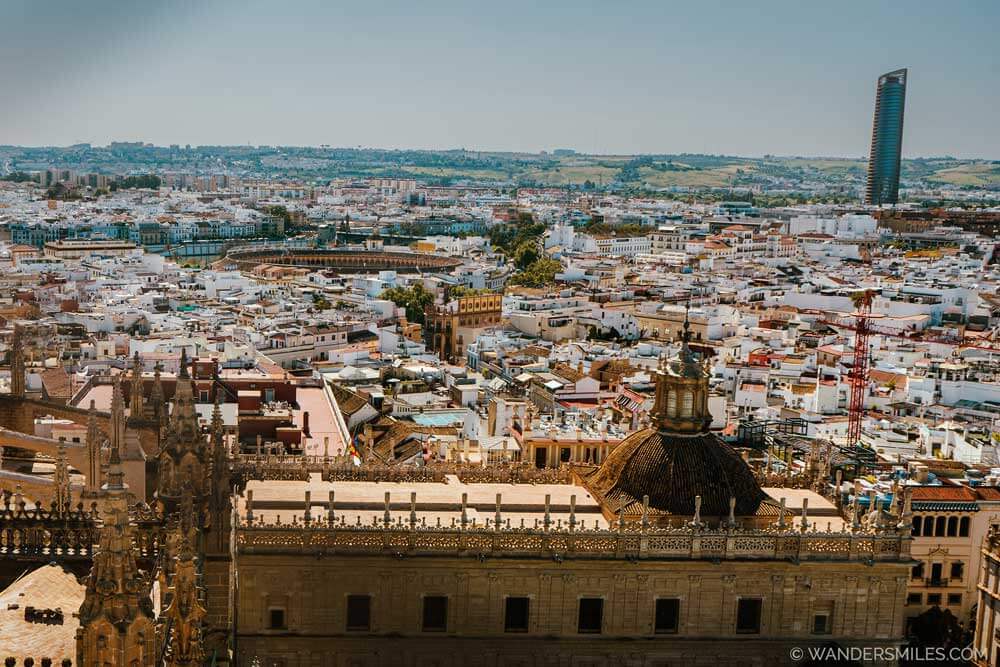
The Giralda Tower, originally constructed as a minaret, is one of Seville’s most recognisable landmarks. Uniquely, the demanding climb to the top is made via ramps rather than stairs, allowing guards to ride up on horseback back in the day. Along the way, there are window stops where you can enjoy the breeze and sweeping views across the city. Visiting both the cathedral and the tower offers essential insight into Seville’s religious, cultural, and architectural heritage.
|| BOOK TICKETS & TOURS AT SEVILLE CATHEDRAL
- High Altarpiece in Seville Cathedral
- Sala capitular (Chapter House), Seville Cathedral


Wander Around The Plaza de España
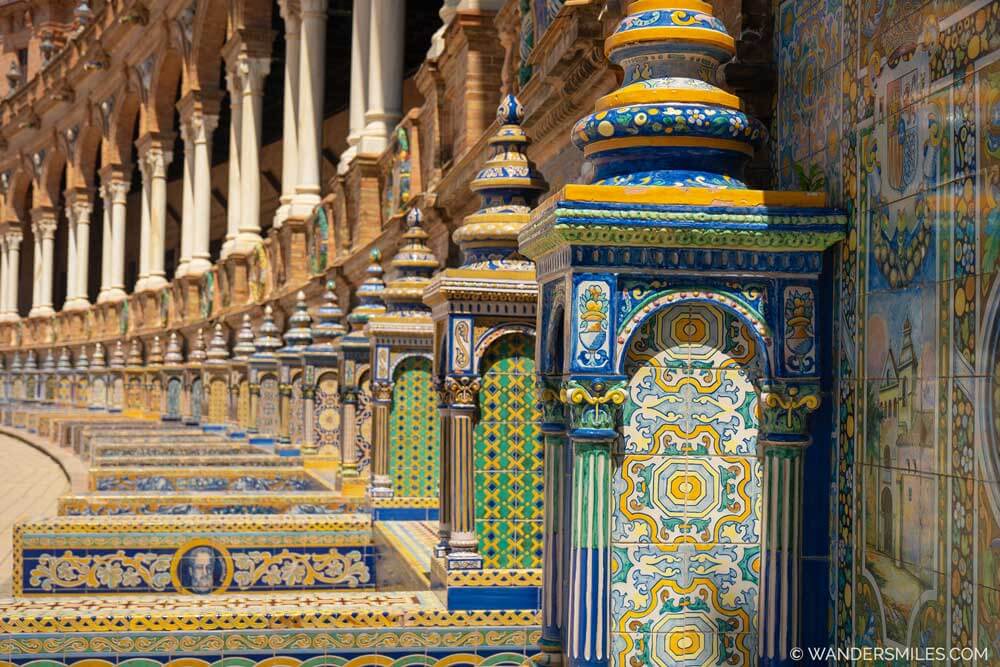
Plaza de España is one of Seville’s most impressive and photogenic landmarks. Built for the 1929 Ibero-American Exposition, this vast semi-circular plaza combines Renaissance Revival and Moorish architectural elements on a grand scale. A canal runs along the plaza, crossed by elegant bridges, while colourful azulejo tiles depict scenes and maps from every Spanish province.
Not only is Plaza de España part of Seville’s history, it’s a hive of activity. You’ll see dramatic fountains, street musicians, and occasional flamenco performances echoing across the square. You can even rent a small boat to row along the canal, earning it the nickname “the Venice of Seville.”
The plaza sits inside María Luisa Park (Parque de María Luisa), where you can continue your walk among shaded avenues and tiled pavilions. Originally part of the gardens of the baroque San Telmo Palace, the park was donated to the city in 1893 to create a large public green space.

See the Light Show At Metropol Parasol (Las Setas)
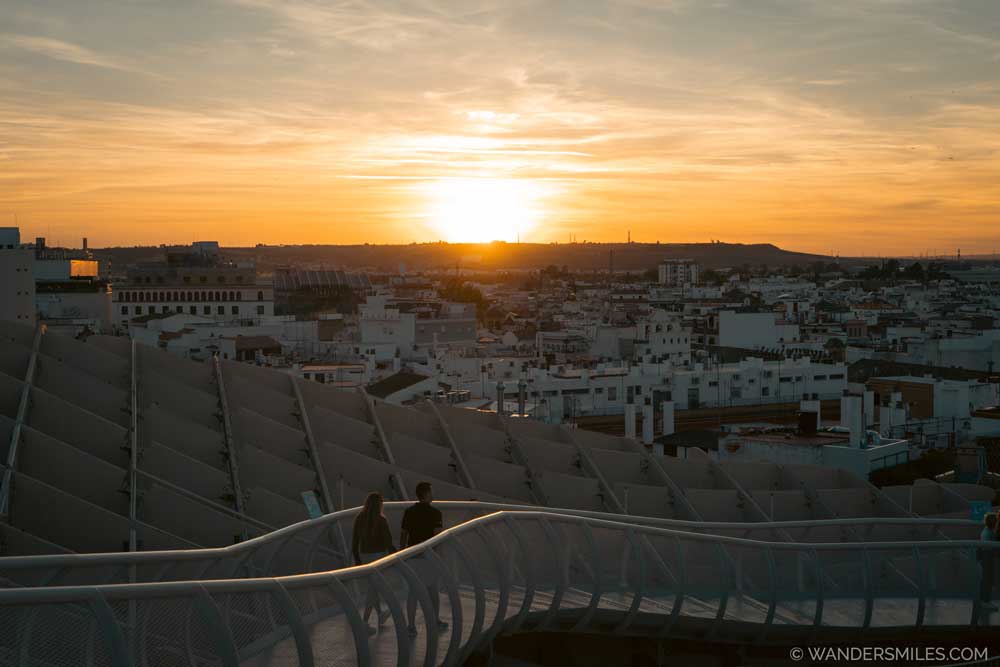
Metropol Parasol, locally known as Las Setas (The Mushrooms), is one of Seville’s most contemporary and eye-catching landmarks which contrast with the surrounding historic streets. Designed by German architect Jürgen Mayer and completed in 2011, the vast sustainable wooden structure was built as part of an ambitious regeneration project to revitalise Plaza de la Encarnación and host a farmers’ market, archaeological museum, restaurants and a panoramic terrace.
By day, you can walk along the elevated pathways for sweeping views across Seville’s old town and rooftops. The real magic happens after dark, when a colourful light show transforms Las Setas into a glowing spectacle. I loved watching the illuminated curves of the structure create an almost futuristic atmosphere. My top tip is to book your time to coincide with sunset so you get the best of both worlds.
|| BOOK TICKETS TO LAS SETAS DE SEVILLA

See The ruins In The Antiquarium Museum
Located beneath Metropol Parasol, the Antiquarium Museum delves into Seville’s ancient past. This underground archaeological site preserves Roman and early Islamic ruins discovered during construction in the area. Walking along the raised platforms, you’ll see remarkably well-preserved mosaics, Roman houses, streets, and fish salting factories that reveal what daily life once looked like centuries ago.
Visiting the Antiquarium shows that Seville’s story stretches far beyond its famous churches and palaces, and it’s a much quiteer experience. It also pairs perfectly with a visit to Las Setas above, combining ancient history with modern architecture in one stop.

Stroll Around Barrio Santa Cruz
Once Seville’s Jewish quarter, Barrio Santa Cruz is home to major attractions such as Seville Cathedral and the Real Alcázar, but it is also a wonderfully tangled maze of narrow streets and small plazas. One of its most historic corners is the Square of the Three Crosses (Plaza de las Tres Cruces), which marks the former site of the Santa Cruz church. The church was built on the remains of a synagogue that was converted into a Christian place of worship and renamed Santa Cruz. In 1811, it was demolished by French troops as part of wider urban redevelopment, with the congregation later relocating to a church on Calle Mateos Gago.
I got the historical context from a guide, then returned to wandering without a map. Noticing the details of Barrio Santa Cruz is part of the experience, from flower-filled balconies overhead, tiled street signs, and hidden courtyards. Food lovers are equally well catered for. Barrio Santa Cruz is also home to top-class tapas bars and traditional restaurants, with La Bartola and Bodega Santa Cruz Las Columnas among my personal favourites.

Visit the Flamenco Museum
The Flamenco Museum is an excellent place to deepen your understanding of one of Andalusia’s most passionate art forms. I stumbled across it by accident on one of my many “go with the flow” mornings. A member of staff kindly walked me through the interactive exhibits, costumes, paintings, and music, explaining the origins and evolution of flamenco. I was fascinated to learn that women were once flamenco guitarists until the practice was outlawed during the Franco years and has never fully returned to its earlier form.
After visiting the museum, you can book a live flamenco show in a traditional tablao to experience the raw emotion of the performance up close. The intense footwork and soulful singing create a powerful atmosphere that is impossible to forget.

Visit Museo de Bellas Artes
As an art lover, the Museo de Bellas Artes was an essential stop on my Seville itinerary. The museum is housed in the former Convent of La Merced, a 17th-century building centred around serene Mudéjar-style courtyards and its elegant setting is a fitting backdrop for one of Spain’s most important fine art collections. Unlike some of the Seville’s major sights, the Museo de Bellas Artes felt refreshingly uncrowded allowing you to truly appreciate the artwork.
The focus is on Spanish art, particularly works from the Sevillian School of the 17th century. Hanging on the walls are masterpieces by Murillo, Zurbarán, and Valdés Leal, artists whose lives and work were closely tied to Seville. Many of the paintings explore religious themes, scenes of daily life, and the dramatic intensity of the Spanish Baroque period. A prominent piece for me was the Tríptico del Calvario by Flemish painter Frans Francken I, which commands attention within the collection.

Visit Casa de Pilatos
Casa de Pilatos is a stunning Andalusian palace that perfectly represents Seville’s architectural fusion of Mudéjar, Gothic, and Italian Renaissance styles. As you meander through this noble residence, your eye is drawn to richly patterned azulejo tiles, finely carved wooden doors, painted ceilings, and long marble-lined corridors that reveal the wealth and taste of its former owners.
The palace was built in the late 15th century by Pedro Enríquez de Quiñones and later expanded by his son, Fadrique Enríquez de Rivera, the first Marquis of Tarifa. It was Fadrique’s pilgrimage to Jerusalem in 1519 that led to the building becoming known as “Pilate’s House,” a reference to the Via Dolorosa.
At the heart of the palace is a beautifully decorated central patio, complete with a well and fountain, framed by elegant Mudejar arches. Lining the courtyard are 24 busts of Roman emperors and Greek gods, alongside classical sculptures and Andalusian details. Explore the chapels and stately rooms, and enjoy the colourful Italian-style garden. Casa de Pilatos is one of the unmissable things to do in Seville and well worth adding to your itinerary.

Palacio de las Dueñas
Palacio de las Dueñas is one of Seville’s most atmospheric historic homes, built in the late 15th century for the Pineda family before passing to the powerful House of Alba, who still own it today. It is best known as the home of the Duchess of Alba, Cayetana Fitz-James Stuart, and the residence remained lived in until her death in 2014, which gives it a far more personal feel than many grand palaces.
Architecturally, Casa de Alba blends Gothic-Mudéjar structure with Renaissance and later additions. You enter through a traditional Andalusian patio filled with orange trees, bougainvillea, and tiled benches, followed by a series of intimate courtyards and rooms.
Inside you’ll find antique furniture, tapestries, family photographs, and even personal belongings. The impressive family art collection includes works by Goya, Velázquez, and Rembrandt. Palacio de las Dueñas adds literary significance to its history as it is also famous as the birthplace of poet Antonio Machado. If you love historic houses, add Casa de Alba to your Seville itinerary.
|| BOOK AHEAD: SKIP-THE-LINE AND GUIDED TOURS FOR PALACIO DE LAS DUENAS

Eat Tapas Around the City
There is no shortage of delicious, traditional tapas bars across Seville, and eating your way around the city is one of the best ways to experience its Andalusian food culture. Classic dishes to look out for include jamón ibérico sliced to order, espinacas con garbanzos (spinach with chickpeas), solomillo al whisky, croquetas filled with ham or salt cod, and tortillas, often paired with local wines or sherry.
You can easily do this independently by hopping between neighbourhood bars, standing at the counter, and ordering a dish or two at each stop. If time is tight, or you want deeper insight into local food traditions, a guided tapas tour is a great option. You’ll visit well-loved spots, learn what to order, and hear the stories behind the dishes.
|| CHECK OUT THE FOOD TOURS IN SEVILLE

Visit Torre del Oro
Torre del Oro is a historic defensive tower located along the banks of the Guadalquivir River. Built in the 13th century during the Almohad period, it once played a key role in protecting the city and controlling river access. The tower now houses a small maritime museum that explores Seville’s naval history and its connection to the Age of Discovery.
If maritime hisry isn’t your bag (although it is pretty interesting), climbing to the top is comes with lovely views of the river, nearby bridges, and the Triana neighbourhood across the water. While the museum itself is modest, the historical significance and scenic setting make Torre del Oro worth a visit.

More Andalucía Reads You May Like
Walk Through Arco de la Macarena
Arco de la Macarena is one of the last remaining city gates from Seville’s medieval walls. Located in the Macarena neighbourhood, this historic arch once served as a main entrance to the city.
Through the arch, you’ll find the Basilica of La Macarena, home to one of the city’s most revered religious icons including the 17th-century statue of the Virgin of Hope (Virgen de la Esperanza Macarena). Visiting Arco de la Macarena provides a different perspective on Seville and it’s a rewarding stop for travellers interested in exploring lesser-known corners of Seville. The surrounding area has a less touristy feel, with traditional bars and neighbourhood life unfolding around you.

Take A Trip To Sierra Norte de Sevilla
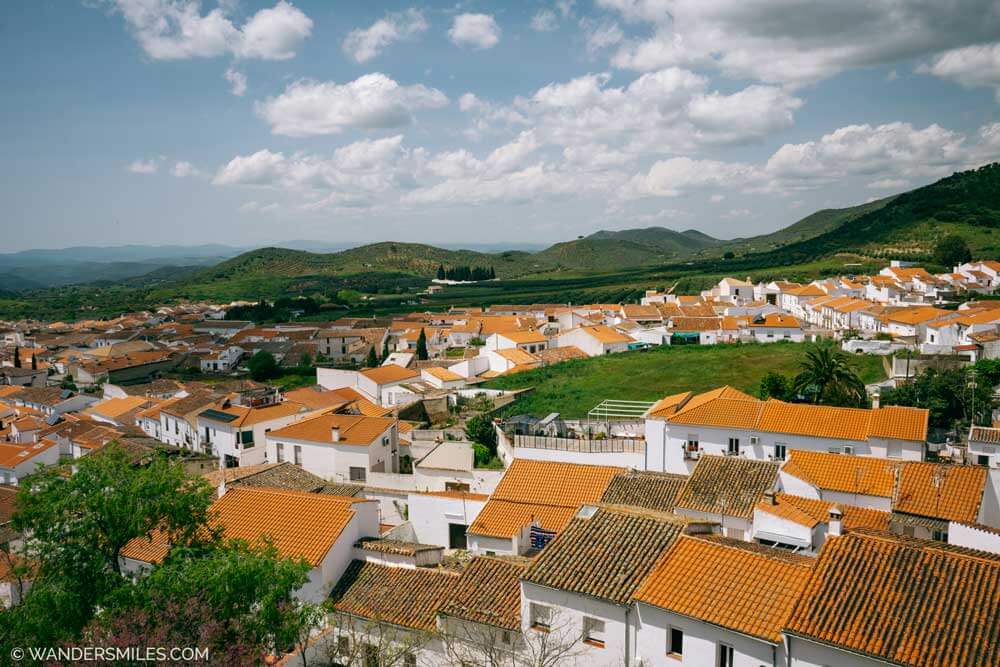
Leaving the big city for a slower Spanish adventure is a decision you won’t regret. Head to Sierra Norte de Sevilla for a refreshing escape into Andalusian nature. This mountainous natural park is filled with rolling hills cloaked in greenery and gleaming white villages. It is an ideal landscape for hiking and cycling, while the wider Sierra Morena range is a year-round haven for birdlife, from the Eurasian golden oriole to the rare Spanish imperial eagle.
To truly recharge, staying longer than a day is recommended. Villages such as Cazalla de la Sierra invite you to slow down, amble their cobbled streets, spend the dark nights gazing star-studded heavens, and immerse yourself in Andalusian gastronomy. You can sample regional cheeses, local olive oils, and traditional tapas dishes to soak up the cava. Sierra Norte is a great choice if you want to balance Seville’s cultural sights with time outdoors.
|| RELATED READ: HOW TO EXPLORE SIERRA NORTE DE SEVILLA
Travel Tips For First-Timers In Seville
Advice On Visiting Museums In Seville
To make the most of your first visit to Seville, plan ahead and book the major sights early to avoid disappointment.
- Book the Catedral de Sevilla and Real Alcázar on different days. Both operate timed entry, and you’ll enjoy them far more without rushing from one UNESCO site to the next.
- Always check opening days and times before you go. Some major attractions close on Mondays, while others stay open, and hours often change on public holidays or between seasons.
- Free entry is sometimes available too. Each museum sets its own rules. Some offer free access to Seville or EU residents, while others have specific free days or hours, often late in the day.
BOOK IN ADVANCE || TOURS & TICKETS FOR SEVILLE’S ATTRACTIONS
How To Get Around Seville (And Beyond)
Seville is an easy city to navigate on foot. Most major sights sit within a compact historic centre, so you can walk between neighbourhoods without needing transport. The riverfront, Santa Cruz, the cathedral area, and the main plazas all connect naturally, and wandering between them is part of the experience.
For longer distances, the metro and tram system are simple to use and well connected to outer districts. Renting a bike with the SEVICI App is also a great option as the city has an excellent network of cycle lanes and flat terrain, making it comfortable even if you rarely cycle at home. If you want a slower perspective, consider a boat trip along the Guadalquivir River to see Seville’s famous attractions from the water with your feet up.
For day trips beyond the city, regional trains and buses run frequently to nearby towns and natural areas, so you don’t need to rent a car in Seville unless you plan to explore more remote parts of Andalusia.
Is Seville Safe?
Seville is a very safe city to visit, including for solo travellers. The centre stays lively into the evening, especially around Santa Cruz and the cathedral area. The main concern is pickpocketing in crowded spots, so keep bags zipped, carry them in front of you, and avoid leaving valuables on café tables. Areas outside the centre are generally calm, but late at night a taxi can be the easier option if you’re far from your accommodation.
It’s also wise to travel with insurance — not because Seville is felt unsafe, but to cover delays, lost items, or small mishaps that can happen on any trip. And you just never know what mishaps may happen including delays, lost luggage and damaged items.
GET A QUOTE || 5% Off HeyMondo + Safetywing
PIN: 3 Days In Seville Spain


Disclosure: This post contains affiliate links, which means I may receive a small commission if you click a link and purchase something that I’ve recommended. It comes at no cost to you. Thank you for your support.