
Ethnic Handicrafts in Sapa: Traditional Souvenirs From The Villages Of North Vietnam
LAST UPDATED: 27th March 2026
Planning a trip to Sa Pa and wondering which traditional souvenirs are truly worth bringing home? The ethnic markets in Sapa are tempting, but the real story is in the villages scattered across the Lao Cai Province.
In the Hoàng Liên Son Mountains, Hmong, Dao, Giáy, Tày and Xa Pho communities still farm rice terraces and practise centuries-old crafts. These handicrafts were never created as souvenirs. They started as traditional clothing for the bitter winters, baskets for harvest and bamboo paper for spiritual rituals.
I hiked to villages such as Ta Van and Sin Chai, joined workshops at women’s cooperatives and interacted with the artisans behind the ethnic handicrafts in Sapa. When you step off the beaten track to meet the makers, buying a souvenir becomes a lasting memory from that connection.

About The Ethnic Communities in Sapa
Ethnic Communities in Lao Cai Province
Sa Pa sits high in the Hoàng Liên Son Mountains of northern Vietnam, close to the Chinese border. The town is constantly expanding as the tourist demand grows and there is a varied mix of cultures living side by side.
Vietnam as a country officially recognises 54 ethnic groups. Several of those communities live in Sapa and in the surrounding Lao Cai Province. The most visible are the Hmong, Dao (Red Dao), Giáy, Tày and Xa Pho.
Each group has its own language, clothing, rituals and farming traditions. You notice it straight away in the markets. Take a look at the designs on indigo-dyed jackets, embroidered headscarves and silver jewellery. The symbolic patterns that tell you exactly which village someone comes from.

Life in Lao Cai Province still follows the agricultural calendar. Rice terraces weave through the hillsides and provide food for local families. Buffalo graze on steep slopes, and ducks paddle through the paddies, acting as natural pest control and fertiliser.
As you hike along the trails through terraces and villages, you will spot wooden storage huts that stand on the hills to protect harvested rice, and outside timber houses corn hangs drying in the mountain air. Families farm together, and knowledge passes from one generation to the next, rarely written down.


How To Buy Genuine Souvenirs from Sa Pa
When you buy souvenirs directly from the artisans from the villages, you are not just buying a product, you are supporting a living culture that continues to adapt while holding on to its roots.
Visit the Villages in Lao Cai Province
I came home with embroidered scarves, intricate hanging decorations now tucked away in my Christmas box, and a hand-stitched tribal wallet. I also picked up a crossbody phone bag, which is clearly adapted for modern life but made from traditional woven fabric.
I bought all of this before I had spent any real time in the touristy town of Sa Pa. I had a more serene and culture-led experience by travelling with G Adventures. We hiked through villages such as Ta Van and Sin Chai and took part in workshops at women’s cooperatives.
Meeting the makers in their own villages, with a reasonable fixed price (no haggling needed), changed the experience completely. You could see the work, ask questions, and understand the process. Knowing the piece was authentic — and exactly who made it — made each purchase far more meaningful.
Support Local in Sapa
If you only have time to explore Sa Pa town, you can still support local artisans. Small shops and market stalls sell handmade textiles and crafts created by ethnic minority communities in the surrounding villages.
- Indigo Cat – A 100% Hmong-owned shop offering handmade batik, embroidery and hemp products crafted using traditional techniques.
- HTX Tho Cam Pho Nui – A brocade cooperative selling genuine handwoven textiles and accessories made by local artisans.
- Local Markerts – Visit Coc Ly Market (Tuesday) and Sapa Love Market (every Saturday night)
Buy Sapa Handicrafts in Hanoi
After leaving Sa Pa, I still wanted to support ethnic minority artisans before flying home. If you find yourself in Hanoi, these shops focus on handmade, community-led products:
- Mountain’s Color – A social enterprise selling 100% handmade goods created by ethnic groups in northern Vietnam.
- Love From The Mountains – Stocks handcrafted pieces made by artisans from three ethnic communities.
- Better World Hanoi – Offers locally made jewellery and ethnic crafts alongside products from NGOs and Fair Trade organisations, with 5% of profits supporting landmine removal projects in Vietnam.
- Chie Dùpùdùpà – A Fair Trade boutique specialising in handicrafts produced by ethnic communities in northwest Vietnam.
|| REALTED READ: GUIDE TO TRAVELLING VIETNAM DURING TET HOLIDAYS

Ethnic Handicrafts in Sapa
Wax-Resist Batik
For Hmong communities, batik is closely tied to identity. In Sa Pa, artisans practise wax-resist batik combined with traditional indigo dyeing. It’s a slow, hands-on process that demands patience.
The process starts with hemp. Women grow, harvest, and spin the fibres by hand before weaving them into cloth. Hemp, often referred to as “spirit cloth”, thrives in the mountain climate and produces a durable, breathable fabric suited to daily wear.
Once the cloth is ready, melted beeswax is applied using a small metal or bamboo tool. The artisan draws freehand with the beeswax on the fabric. Most motifs are geometric — spirals, squares and maze-like lines — with symbols linked to protection, fertility and ancestral ties.
I joined a batik workshop with Black H’mong women at the Muong Hoa Cooperative. Drawing with hot beeswax is far harder than it looks. I attempted an intricate rice terrace scene inspired by one of my photos. It quickly became clear that simple, bold lines work best.
After waxing, the fabric is dipped multiple times into natural indigo vats. The indigo leaves ferment for days to create the deep blue dye. Each immersion darkens the cloth. When the right shade is achieved, the textile is boiled so the wax melts away, revealing crisp white patterns against blue.
Traditionally, Hmong women create their clothing from start to finish. Batik skirts appear at festivals, weddings, and Lunar New Year celebrations. Tie-dye techniques are also used, with thread tightly wrapped or stitched before dyeing to create additional patterns.
Batik scarves and bags are big business with visitors. Artisans create clothing and bags to provide income, but the craft still holds its strongest meaning within community life and ceremony.

Brocade Weaving
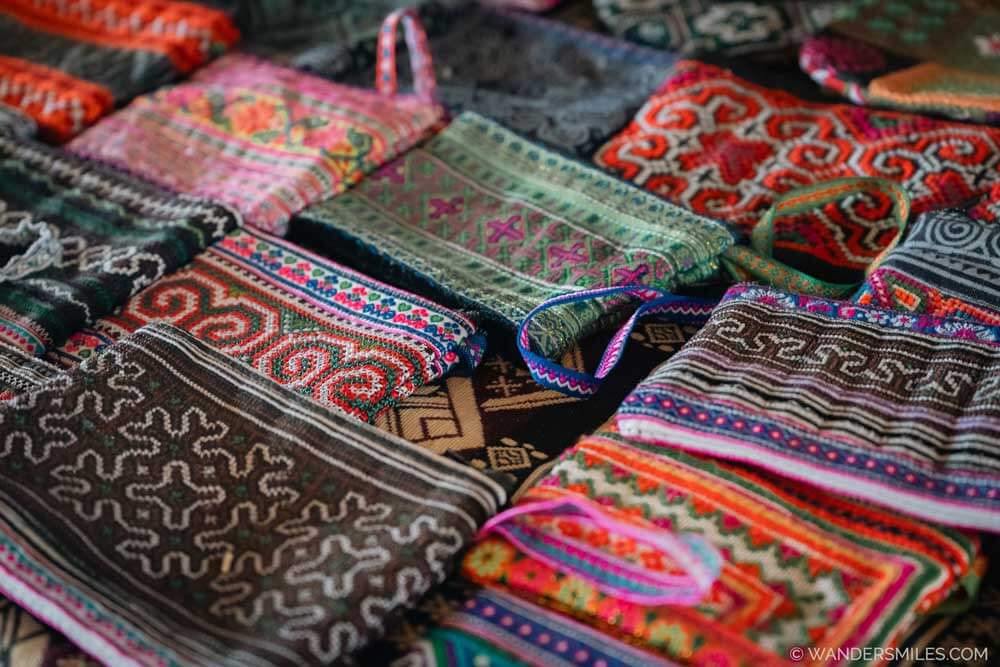
Brocade weaving in Sa Pa demands precision and patience. Every motif carries meaning. Unlike batik, which decorates the finished cloth, brocade patterns are woven directly into the fabric itself.
The process begins long before the loom. Hemp is harvested, fibres are spun by hand, and threads are dyed in natural colours. Only then does the weaving start. Many Red Dao and Hmong women work on wooden frame looms or portable backstrap looms secured around the waist. Girls grow up watching mothers and grandmothers weave their creations.
During weaving, coloured threads are inserted by hand to form raised motifs. Red dominates in Dao textiles, symbolising luck and protection. Green often represents growth. Yellow can signal prosperity. Geometric designs appear most frequently, such as diamonds, crosses, and stepped shapes, alongside patterns inspired by mountains, rice terraces, and flowing water. Some motifs express family bonds and wishes for the future.
Traditionally, brocade trims edge jackets, baby carriers and ceremonial outfits. Details on sleeves and collars can reveal marital status or ethnic identity.
As tourism grows, some villages now produce brocade accessories for sale. The challenge is faster production versus traditional methods. Handwoven pieces show small imperfections that prove a human made it with love, not a machine.
Bamboo Paper Making
Bamboo paper making is a centuries-old tradition primarily maintained by the Dao and H’mong communities where it is tied closely to spiritual life.
Creating bamboo paper is a long process that begins in the forest. Young bamboo is cut, soaked and then boiled for hours to soften the fibres. After boiling, the fibres are pounded with wooden mallets until they break down into pulp, which is then mixed with water. A rectangular screen made of fine mesh is dipped into the mixture and lifted carefully. A thin layer of pulp settles evenly across the surface. The sheet is then laid flat to dry in the sun. The finished paper is slightly textured and off-white in colour.

I joined a workshop with H’Mong women in Nam Than Village, who demonstrated each stage and encouraged us to try for ourselves. They even dressed me in a traditional jacket so I could fully step into the experience. It looked effortless when they did it. Let me tell you, it was not.
Afterwards, we visited the home of the txiv neeb, a H’Mong shaman. The connection between the two became clear. Bamboo paper has long been central to H’Mong spiritual practice. It is used in rituals to honour spirits and ancestors.
According to H’Mong belief, bamboo paper invites good fortune when presented to deities. During major festivals, families burn symbolic paper offerings, believing the rising smoke carries them to the spirit world. Perforated bamboo sheets adorned with chicken feathers are placed on ancestral altars as part of the ritual, symbolising protection from evil spirits and misfortune.


RELATED READ || EXPLORE SAPA OFF THE BEATEN PATH
Herbal Incense Making
The craft of herbal incense making draws on knowledge of local medicinal plants. Women gather leaves, bark and roots from surrounding forests. Common ingredients include cinnamon bark, star anise, black cardamom and various native herbs.
The materials are dried naturally, then ground into a fine powder using stone mortars. This powder is mixed with water to form a paste. Thin bamboo sticks act as the base. Artisans roll the paste evenly around each stick by hand. The incense dries in the sun for several days, turning from dark brown to a soft earthy shade. When burnt, it produces a gentle, herbal aroma rather than heavy smoke.
Burning incense is a sacred practice used to purify spaces and connect with ancestors. The rising smoke is believed to clear negative energy and carry prayers to the spiritual world.
People light incense in homes, pagodas and temples to invite harmony and prosperity. It plays an especially important role during Tết (Lunar New Year) and on death anniversaries, when families gather to honour those who came before them.
Local cooperatives now host workshops and produce herbal incense for travellers who want a natural alternative to the synthetic fragrances that dominate the global market. When you buy from these community-run groups, you help safeguard traditional plant knowledge and the cultural rituals tied to it.
I have been lighting my bundle at home, and each time the soft, earthy scent drifts through the room, I am transported straight back to the mountains of Sa Pa.

Basket Weaving
Basket weaving is still one of the most practical crafts in Sa Pa. Men often take the lead, although women are involved too. The skill usually passes from father to son, learnt through years of watching and practising.
Bamboo or rattan is harvested from nearby forests. The material is split into thin strips using knives, then shaved to achieve uniform thickness. For the baskets, the base is woven first, usually in a tight criss-cross pattern. Vertical stakes are inserted, and horizontal strips are woven around them to build the sides. A well-made basket can last years, and in farming communities, durability matters.
The same basketry skills extend beyond farm tools. Artisans also apply these techniques to make traditional Vietnamese conical hats, lanterns and tea trays, along with many other everyday items.
Each design has a purpose. Large back baskets carry rice, corn or firewood. Smaller ones store vegetables. Some are shaped specifically for fishing. As you hike through the villages around Sa Pa, you still see them in daily use, strapped to backs along steep mountain paths.
I appreciate you might not want to carry a full-sized harvesting basket home for your weekly shop. The good news is that local artisans now create smaller, practical items using the same techniques — handwoven fans, trinket baskets, shoulder bags, shoes and table mats — making it easy to support the craft in a way that fits your life.

Handy Links for Visiting Sapa
RECOMMENDED 5 Days in Sapa Tour with G Adventures to experience life beyond the busy town of Sapa, meet local artisans of traditional handicrafts, and you get to hang out with like-minded travellers. I was super impressed with the itinerary and organisation.
Don’t forget travel insurance! I used HeyMondo for my Vietnam trip. They have 24-hour medical assistance, 365 days a year with single, multi-trip, and long-stay insurance (up to 3 months), cover for COVID-19 and non-refundable expenses. They give a little back too by contributing to ‘Doctors Without Borders’. DISCOUNT TO MY READERS: Get 5% off your travel insurance with HeyMondo.
Thank you to G Adventures for supporting me on my mission to write this guide on ethnic handicrafts in Sapa for responsible travellers. All opinions are my own.
PIN This Blog About Ethnic Handicrafts in Sapa


Disclosure: This post contains affiliate links, which means I may receive a small commission if you click a link and purchase something that I’ve recommended. It comes at no cost to you. Thank you for your support.






I loved reading it about your experience and mostly, about the culture that still relies on old traditions. When buying from local artisans you get so much authenticity than when you are buying from a retailer. Would you say that the price difference was higher when acquiring hand-made products versus those made on a larger scale?
Thank you for your kind words. I didn’t actually look at any prices for other products. In this situation, I tend to target shops or markets that sell the genuine thing, that support cooperatives and social enterprises.
Thank you for this beautiful and useful article! As an Italian who lives in Cambodia and visits Vietnam quite often, it’s refreshing to see an article focused on supporting locals and traveling responsible.
Thank you — that means a lot. I try to seek out ways of supporting local communities when I travel, and I hope writing blogs helps too.
Sounds like a wonderful experience. I love learning about other cultures in an interactive way, and it’s amazing to think how much art, clothing, and fashion differes around the world.
Same! I love learning about the symbolism in the designs too, as they represent important elements in their community such as harvest or family.